


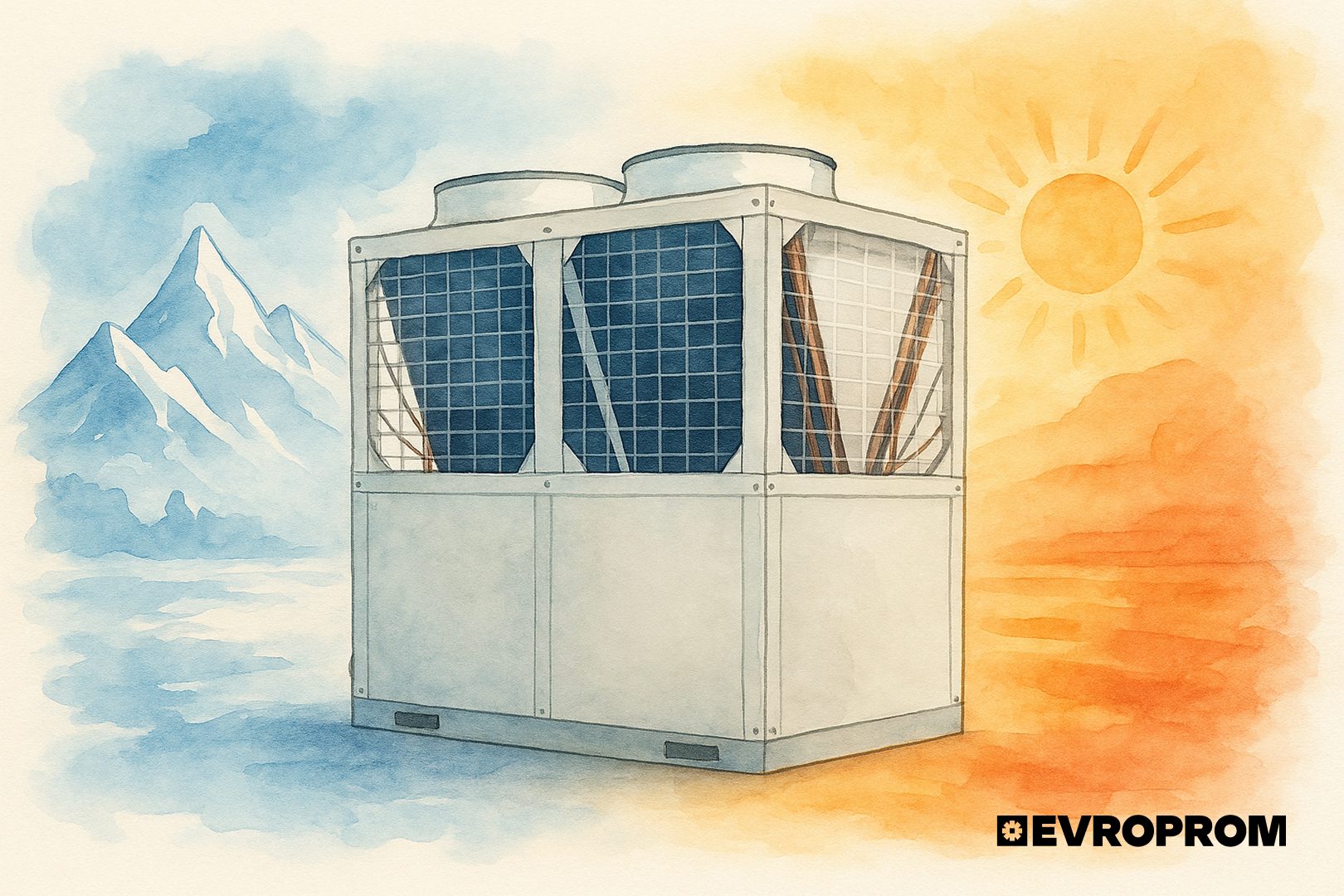
Chiller Heat Pump: Overview

Heat pump in heating and cooling systems: principles of operation and selection
Heat pumps (HPs) and reversible chillers are now an important part of climate control systems, providing both heating and cooling for buildings with high energy efficiency. These units utilise renewable energy sources – air, water or ground – to transfer heat, which reduces operating costs and carbon footprint.
Choosing the right type of heat pump and wiring diagram directly affects system efficiency, equipment life and indoor comfort. This article considers the main sources and sinks of heat, classification of systems with heat pump, their principles of operation, advantages and limitations. The information obtained will help to make an informed choice when designing or modernising building engineering systems.

Fig 1. – Heat pump from our catalogue: Civet WSAN-YMi 71 (cooling capacity 12.9 kW; heating capacity 14.1 kW)
Check out our catalogue of chillers and heat pumps –only proven models from reliable manufacturers, with full technical specifications and adaptation to your conditions.
1. Heat sources and heat sinks
Using heat pumps to heat and/or cool a building requires heat sources and heat sinks. A heat source is the medium from which heat is extracted by the heat pump’s evaporator. A heat sink is the medium into which heat is removed by the heat pump condenser.
The choice of heat source and heat sink depends on the availability of sources, climatic conditions, costs and how the heat/cold is distributed.
A classification of common heat sources and sinks has been proposed by ASHRAE. This classification is given below.
Air as a heat source/sink
Two options for using air as a heat source or absorber are currently being considered:
- outdoor air;
- exhaust ventilation air.
Water as a source/absorber of heat
Water used as a heat source or absorber can come from a variety of sources:
- groundwater;
- lakes, rivers or oceans;
- closed water loops;
- wastewater;
- condensation water.
Earth as a source/sink of heat
The ground can be used as a heat source or absorber using three basic types of ground heat exchangers:
- Vertical ground heat exchangers
- very stable heat source/sink temperature ( )
- small ground area required ( )
- high cost and possible drilling difficulties (-)
- Horizontal ground heat exchangers
- lower cost ( )
- significant influence of outdoor temperature at shallow depth (-)
- larger ground area required (-)
- Buried heat exchangers with direct expansion (DX)
- Vertical ground heat exchangers – consist of U-shaped tubes installed in vertical boreholes up to 100-120 metres deep.
- Horizontal ground heat exchangers – consisting of long single or multiple coil-shaped heat exchanger tubes buried 1-2 metres deep.
2. Classification of systems
Classification of systems is divided into 2 groups, first – where the refrigerant is closed in the volume of the aggregated heat pump (CHP) / chiller, the second – the refrigerant is used in heat exchange with a heat source and/or absorber
Aggregated system:
- Air-to-water TH (air-cooled chiller)
- Water-to-water TH (water-cooled chiller)
- Water/air/water TH (double condenser chiller)
- Water-to-air TH
- Air-to-air TH
- Brine-water TH
- TH “brine-air”
- Roof-top unit (Roof-top unit)
Open system with direct expansion (DX):
- Split systems
- VRF systems
- Ground-coupled DX heat pump (Ground-coupled DX heat pump)
A unit is called reversible if it is equipped with a refrigerant switching device capable of reversing the direction of the cycle (see Fig. 2 for an example).

Fig. 2 – Four-way valve, responsible for changing the direction of the refrigerant flow.
The term “chiller” can be used instead of the corresponding term “heat pump” to emphasise that the main purpose of the unit is cooling, e.g. when it is calculated based on the maximum cooling load.
Overview of heat pump systems
Systems consist of one or more units (blocks) and other components. They can be divided into three main categories:
- Reversible systems without heat recovery: alternating heat and cooling generation;
- Non-reversible systems with heat recovery: mainly designed for cooling, but can extract heat on the condenser side while producing cold on the evaporator side;
- Reversible heat recovery systems: alternating or simultaneous heat and cold production.
Wondering which heat pump system is right for your property? Contact EVROPROM engineers – we will find the optimal solution, taking into account the climatic conditions, available heat sources and operational peculiarities.
2.1 Reversible systems without heat recovery
Reversible air-to-water heat pump
Air-cooled chillers are the most common technology in the European air conditioning market, accounting for 85% of chiller sales in the commercial sector [EECCAC, 2003].
The system can be reversed by means of a refrigerant switch (see Figure 3), which reverses the direction of flow through two heat exchangers:
- In cooling mode, the air heat exchanger acts as a condenser, removing heat to the outside air, and the water heat exchanger acts as an evaporator, transferring cold to the distribution system.
- In heating mode, the air heat exchanger works as an evaporator, extracting heat from the outside air, and the water heat exchanger works as a condenser, transferring heat to the distribution system.


Fig. 3 – Chiller air cooling with refrigerant switch
Reversible units can be connected to:
- A two-pipe water distribution system, in parallel with a standby boiler, if heating and cooling loads are not expected to be present at the same time (see Fig. 4a);

Figure 4a: Reversible air-to-water heat pump connected to a two-pipe distribution system in series with the boiler

Figure 4b: Reversible air-to-water heat pump connected to a four-pipe distribution system via hot water distribution
- Four-pipe water distributionsystem for buildings with simultaneous heating and cooling loads. The chiller is connected to both cold water pipes and hot water pipes (see Fig. 4b). In this case, the final heat supply devices must be compatible with the low water temperatures characteristic of a reversible unit operating in heating mode without boiler intervention.
Reversible geothermal (groundwater, groundwater) / hydrothermal (surface water) heat pump (without heat recovery)
A reversible geothermal heat pump (GHP) consists of a reversible water-to-water unit, which is connected on one side to the building distribution system and on the other side to a brine or water circuit connected to a geothermal heat source/sink.
The system is reversible by means of a refrigerant switch in the heat pump unit, which reverses the direction of flow through the two heat exchangers (see Fig. 5):
- In cooling mode, the geothermal-side heat exchanger acts as a condenser, removing excess heat to the ground or surface water through a water (or glycol-water) loop, while the water-side heat exchanger acts as an evaporator, transferring the cold to the distribution system.
- In heating mode, the geothermal-side heat exchanger operates as an evaporator, absorbing heat from the geothermal source through the water circuit, while the water-side heat exchanger operates as a condenser, transferring heat to the distribution system.
In addition, if the temperature of the geothermal source is within the temperature range of the building distribution system, the system can be designed to operate in free-chilling (sometimes also called free-cooling) mode: the water circuit bypasses the heat pump unit and is connected to the building distribution system via an additional heat exchanger. The size of the heat exchanger and the control strategy for the transition from cooling to free-chilling and back again must be carefully designed depending on the geothermal source temperature and the cooling load profile of the building.
The deep geothermal closed loop functions as a seasonal heat storage system:
- Inthe summer, the heat pump operates in cooling mode and dissipates heat into the ground or groundwater through the loop;
- In winter, this heat is extracted from the ground or groundwater through the loop.
To assess the potential for geothermal heat, we suggest looking at the soil temperature graph in Fig. 6

Fig. 5 – Reversible geothermal heat pump without and with free-chilling mode

Fig. 6 Average ground temperature by month at different depths (data for Ireland 2006-2015)
2.2 Non-reversible systems with heat recovery
Water chiller with heat recovery
Water-to-water heat pumps are typically used for cooling; they are connected to cooling towers or dry coolers to remove heat. As these units are not normally designed to be used as a heat source, water-to-water heat pumps are not normally used in heating mode and are most commonly referred to as water chillers.
Heat recovery is an attractive option for water chillers. Heat can be recovered by means of a heat exchanger installed in the hot water circuit or directly in the refrigerant circuit. Thus, this kind of system can produce heating and cooling at the same time (see Figure 7).


Figure 7 – Water chiller with additional heat recovery heat exchanger in the water circuit
As the heat pump can only produce hot water, if cooling is required a boiler is also required for:
- covering the heating demand when there is no cooling load;
- cover peak heating demand;
- raising the hot water temperature if the final supply devices require a temperature higher than what the recovery heat exchanger can provide (typically 35-40 °C).
The chiller is controlled according to the cooling demand of the building. Part of the condenser’s heat output is transferred to the recovery heat exchanger according to the heating demand and the remainder is dissipated through the cooling tower.
Water chillers show higher efficiency compared to air chillers. Average EER values at rated conditions for EUROVENT certified water chillers (excluding CHF) range from 3.6 to 4.6 depending on the cooling capacity range.
For water chillers EUROVENT also offers a seasonal cooling energy efficiency ratio – ESEER (European Seasonal Energy Efficiency Ratio). The calculation method is the same as for air chillers, except for the definition of test temperatures.
If you are not sure which type of chiller or heat pump system best suits your requirements, our experts can help you choose!
Conclusions
There are many solutions available on the market.
Geothermal systems seem to be the most efficient, but they cannot be applied everywhere. In addition, their capital costs are high.
The choice of final supply devices is important. Using low distribution temperatures for cooling and high temperatures for heating significantly reduces the efficiency of the heat pump.
Radiant heating is a good solution, but its capacity is limited.
The efficiency of auxiliary devices (fans and pumps) must be considered; their total consumption may be even higher than that of the heat pump unit itself.
Figure 8 shows the unit cost of investment as a function of the average temperature difference. For the supplier technologies that have indicated a cost, the unit investment cost (excluding installation and integration) ranges from 200 €/kW to 1200 €/kW, and the average temperature difference for the different technologies ranges from 20 °C to 190 °C.
The figure shows a general trend: higher temperature differences correspond to higher costs. Within these unit cost ranges, highlighted by the black vertical lines in the figure, the cost is highly dependent on the size and application area of the heat pump for a given technology.

Figure 8 – Unit investment cost as a function of the average temperature difference [Danish Technological Institute August 2023. Report no. HPT-AN58-2]
If you still have questions about equipment selection, please contact Europrom specialists. We will help you to choose a suitable solution and offer reliable chillers presented in our catalogue.

What you get with EVROPROM
Optimal selection of a heat pump system – we take into account available heat sources and heat sinks, climatic conditions, load profile and heating and cooling requirements.
Technical expertise and advice – we explain the advantages and limitations of different connection schemes, help you choose between reversible and non-reversible systems, with or without heat recovery.
A wide range of proven equipment – a wide selection of chillers and heat pumps from trusted global brands, adapted to industrial, commercial and administrative facilities.
Reduced operating costs – through proper design and equipment selection, we improve energy efficiency and minimise heating and cooling costs.
Technical support at all stages – from design and delivery to commissioning and further maintenance.

Author of the article:
Andrey Kohan, Refrigeration Equipment Engineer
30.08.2025