


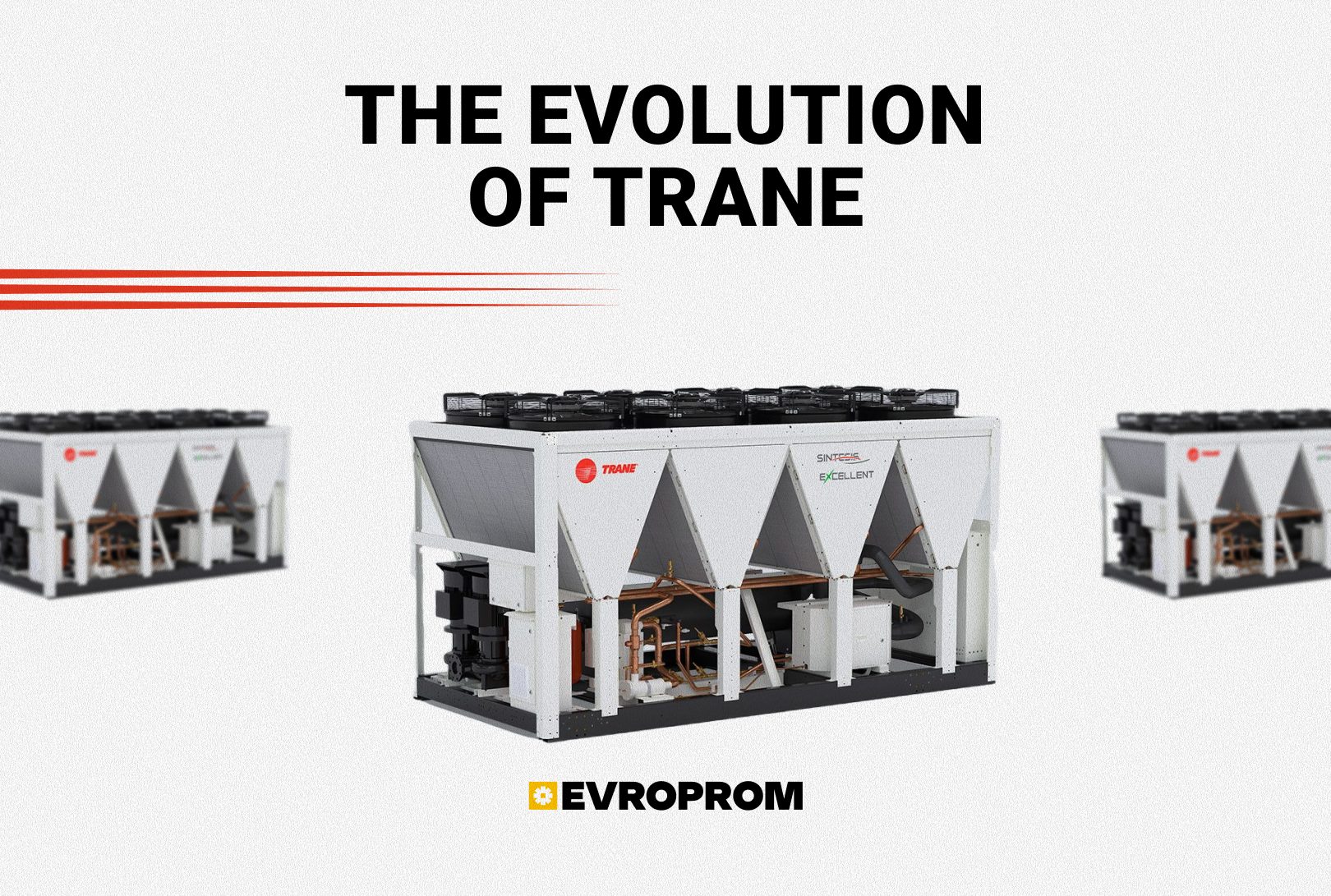
Evolution of TRANE: History, Innovation, and HVAC Technologies

Introduction
TRANE is one of the few brands that has been involved in the development of the HVAC industry. Its solutions have influenced how cooling systems are designed, how large buildings and factories operate, and how the industry understands energy efficiency and equipment reliability.
For the renovation market, this is especially important. When TRANE equipment comes into the warehouse after decades of service, it has, in most cases, retained its structural integrity, compressor life and circuit stability.

Figure 1. Unloading TRANE chillers at EVROPROM’s warehouse
TRANE has always been developed as an engineering laboratory: focusing on structures, process physics, acoustics, vibrations, compressor reliability and automation precision. It is this approach that defines the DNA of the brand – and explains why TRANE chillers have remained operational and predictable under load for decades.
In this article, we’ll explore how the company was formed, who was behind its engineering school, what technologies TRANE was the first to market with and why their equipment is still in demand – both in the primary segment and in the boom market.
Founders and brand DNA: TRANE’s engineering culture
The TRANE story begins not with a corporation, but with an engineering challenge.
In 1885, Norwegian immigrant James Trein opens a small heating and plumbing workshop in La Crosse. The region’s climate was harsh and heating systems were primitive and inefficient. Most homes were losing heat, equipment was unstable, and fuel consumption was too high.
In the 1910s, his son, Reuben Train, a mechanical engineer with a formal education, joined the business. It was he who turned the family business into an engineering company.

Figure 2. James and Reuben Trein
In 1913, TRANE was formalised as The Trane Company – no longer as a service workshop, but as a developer of heating systems.
Early designs that set the style of the company
Trane Vapor Heating System (1910s-1930s)
A low-pressure vapourheating system with more precise temperature control and less energy loss. This was not an adaptation of existing solutions, but an engineering design of its own.
Convector Radiator (1920s)
Reuben Trane created a radically new type of radiator – the convector radiator.
It was lighter, more efficient and took up less space than cast iron radiators.
This development was TRANE’s first major technological breakthrough and gave the company a reputation for changing industry standards.
What’s important to understand about the brand’s DNA
TRANE was developed from the outset as an engineering centre rather than a trading company:
- solutions were developed for the sake of making systems more efficient;
- the company has relied on research and patent work since the early years;
- design elements were created in-house rather than purchased as off-the-shelf components;
- TRANE saw the equipment as part of a complete climate system, not as a separate product.
This foundation allowed the company to take the next step – moving from heating to cooling – and establish itself as one of the HVAC industry’s major innovators.
TRANE’s first generation of innovation: the formation of HVAC technology (1913-1938)
The period 1910-1930s is the time when TRANE laid the technical foundations that allowed it to become one of the leaders in building and process cooling decades later.
1. Convection heating (1920s)
Reuben TRANE’s invention, the Convector Radiator, was not just a new product, but a technological shift.
Unlike traditional cast iron radiators, the new design:
- had a high heat transfer coefficient,
- provided even temperature distribution,
- reduced heat energy consumption,
- was lighter, more compact and cheaper to maintain.
2. From heating to climate control
At the end of the 1920s, TRANE began working with complete systems for buildings – schools, hospitals, manufacturing plants.
The problems TRANE engineers had to solve went beyond heating:
- overheating in southern states,
- high humidity,
- uneven climate loads,
- the growing demands of commercial property.
This gradually led the company naturally to the development of cooling equipment.
1930s: Experience gained leads to refrigeration
By the early 1930s, TRANE knew how to work confidently with convector systems and cooling coils. In 1931, the company introduced its first cooling coils in the Indiana Theater and Rialto – essentially early comfort cooling systems using cold water and a fan.
In 1938, TRANE took a quantum leap with the introduction of the TurboVac™, a semi-hermetic centrifugal chiller with vacuum operation. Its key features are:
- compact, “packaged” design compared to field installation;
- direct drive;
- easy serviceability by the standards of the time;
- high reliability.

Figure 3. Ruben Trein and TurboVac
The TurboVac was TRANE’s entry point into industrial air conditioning and established a principle that the company would develop for decades: the centrifugal chiller as a reliable standard for large facilities.
War, heat transfer and metals: competences that later returned to HVAC (1940s)
During World War II, TRANE, like many US industrial companies, temporarily switched from civilian systems to military tasks. But this did not sideline HVAC development – on the contrary, it gave the company experience with new materials and regimes.
Key engineering episodes from this period:
- Development of aluminium brazed heat exchangers for aircraft engine intercoolers: it was necessary to cool the air after the compressor outside, at high pressures and loads. Standard solutions (copper glue joints) could not withstand the regimes. TRANE, together with aluminium manufacturers, introduced salt bath brazing technology, which made it possible to build a lightweight and robust heat exchanger.
- Similar principles were later used in heat exchangers for the Lunar Rover and other special projects – creating a unique expertise in the design of compact, high-load heat exchangers.
- In parallel, TRANE adapted its condensing and cooling units to process applications (quench oil cooling, etc.) – this broadened the understanding of industrial refrigeration, not just comfort.
In essence, during the 1940s TRANE was learning to deal with higher loads, extreme conditions and new materials. These skills made a direct return to civilian chillers after the war.
The post-war leap: its own compressors and a new generation of chillers (1950s)
After the war, having accumulated experience and equipment, the company consciously bet on strengthening its compressor range.
Since 1946, TRANE has been purposefully developing:
- new centrifugal compressors,
- piston compressors for smaller capacities.
In 1948, in one of the speeches, the company’s management announced plans to bring centrifugal chillers to the market in the range of 50-200 tonnes, possibly up to 300 tonnes.
Already at the ASHVE exhibition in 1951 TRANE demonstrates:
- a range of centrifugal chillers,
- reciprocating compressors,
- self-contained air conditioners,
- various types of fans,
- climate Changer multi-zone systems.
This is the formation of a complete vertical: from fans and heat exchangers to large machines and air management systems.
CenTraVac: the engineering benchmark (1950s onwards)
The next decades were pivotal: TRANE began building machines that set industry standards for decades to come.
In 1960, TRANE introduced the CenTraVac®. It is a centrifugal chiller that for decades has served as a reference by:
- low refrigerant leaks;
- high energy efficiency;
- stable operation in continuous operation;
- service life, which in real objects is measured in decades.
From an engineering standpoint, the CenTraVac is important because it combines:
- elaborate impeller aerodynamics;
- precise mechanics;
- sophisticated lubrication and protection systems;
- low vibration design.

Figure 4. CenTraVac® centrifugal chillers: CVHE, CVHF, CVHH, CDHF, CDHH models
CenTraVac has become an engineering benchmark and has brought TRANE to major projects: airports, data centres, pharmaceuticals, government facilities.
TRANE’s state-of-the-art technology: engineering solutions that define the industry
TRANE remains a brand that develops key components of HVAC systems in-house, rather than purchasing them from third-party manufacturers. Therefore, TRANE’s engineering solutions often have a distinctive signature.
Below are the technologies that form the current portfolio and explain why TRANE technology is in demand both in the primary and secondary market.
1. Proprietary compressors: from screw compressors to modern scrolls
TRANE does not buy compressors from third-party manufacturers – the brand has been developing its own lines for decades.
Helical Rotary Compressors (Helical Rotary Compressor)
One of TRANE’s engineering strengths is its own helical rotary compressor, designed with an emphasis on:
- stability of operation under varying loads;
- low vibration;
- high life expectancy for industrial applications;
- minimal oil leakage.
These compressors have been installed on RTAC, RTHD and a number of industrial series. They are particularly valued on the aftermarket: TRANE screw compressors often continue to operate for decades without major intervention.
TRANE scroll compressors
The CGAX, CXAX, Sintesis and other TRANE air chillers are often equipped with scroll compressors with:
- smooth load output,
- correct operation with frequency control,
- good life on frequent start-stops.
This saves customers from frequent repairs and makes the machines easy to renovate.
2. Microchannel heat exchangers (MCHE)
TRANE started using MCHE before many competitors.
Advantages:
- less refrigerant;
- higher heat transfer efficiency;
- corrosion resistance (aluminium, no galvanic couple);
- low weight and compactness.
For renovated machines this is important:
microchannel batteries give predictable operation and do not need to be replaced as often as copper-aluminium batteries, especially in polluted environments.
3. Automation and control: Tracer, Adaptive Controls, BMS integration
TRANE is characterised by the fact that it has always relied on its own control systems.
Tracer (SC, UC, CH, Summit)
TRANE controllers don’t just control compressors and fans, they analyse them:
- pressure drops,
- thermal loads,
- the dynamic behaviour of the machine.
Functions that integrators value:
- Adaptive Control – protection against accidents without stopping the chiller;
- condensation control algorithms;
- predictive maintenance alarms;
- easy integration into the BMS via standardised protocols.
TRANE is one of the few brands where automation has a real impact on machine life.
4. Energy efficient ranges: Sintesis, CGAX, RTAF
The modern TRANE range has evolved around several principles:
- reducing energy consumption,
- reduced refrigerant charge,
- controllability at low loads,
- compliance with European environmental regulations (ErP, F-Gas).
Sintesis (RTAF, CGAF, GVAF)
Versatile series with emphasis on energy efficiency and performance over a wide temperature range.

Figure 5. Sintesis eXcellent GVAF air-cooled chiller
CGAX / CXAX
Air chillers with scrolls and MCHE, easy to service and renovate.
RTAC / RTHD
Screw and centrifugal units for industrial applications.
5. TRANE Acoustic Engineering
Acoustics has never been an “optional extra” for TRANE. The company took noise as seriously as efficiency, reliability and compressor performance.
Key features:
- vibration control at the level of the frame design;
- low RPM for centrifugal machines → low sound spectrum;
- sophisticated flow aerodynamics;
- entropy optimised compressor impellers;
- measurement standards and certification of noise levels.
Trane Technologies Group: brands and key technology acquisitions
Today, TRANE is part of the Trane Technologiesholding company , which focuses on climate solutions for buildings and transport. Within the group are gathered brands and companies covering different segments of HVAC and refrigeration.

Figure 6. Brands of the Trane Technologies group
Main strategic brands
- Trane
Chillers, heat pumps, roof tops, automation, systems for buildings from offices to large industrial facilities. - Thermo King
Refrigeration for transport: refrigerators for trucks, semi-trailers, containers, railway wagons, buses and marine transport .
European and niche HVAC brands within Trane Technologies
- Thermocold
European manufacturer of chillers and heat pumps: multi-pipe systems, “one machine for heating and cooling” solutions, focused on high energy efficiency and operation with low-GWP refrigerants. - ICS Cool Energy
Specialist in industrial and process cooling in Europe: rental, temporary and permanent temperature control solutions including chillers, fluid chillers, plant systems. - Frigoblock
European supplier of electric and hybrid refrigeration systems for commercial vehicles. Strong competence in diesel-free and low emission systems.
How EVROPROM works with TRANE
For the renovation market, it is important that TRANE technology is designed for a long service life. We see this in practice:
What most often ends up in EVROPROM’s warehouse:
- CGAX, CXAX – compact air chillers on scrolls.
- RTAC – one of the most common screw models.
- RTAF / RTHD – efficient industrial solutions.
- Sintesis – modern machines with good energy efficiency.
What our engineers pay attention to:
- condition of compressors (scroll/scroll);
- frame and vibration isolation;
- residual characteristics of heat exchangers;
- correctness of Tracer operation;
- operation under load and adaptation to the customer’s climate.
Practice shows: TRANE survives renovations well and behaves consistently on test benches – this is a consequence of the very engineering culture that has been built up over decades.

Author of the article:
Tatyana Kohan, marketer
8.12.2025