


Comparison of Heat Exchangers in Chillers: Which to Choose and When

Heat exchangers are key elements of chillers that directly affect the heat transfer efficiency, energy efficiency and reliability of the entire chiller.
In the previous article, we have already discussed the criteria for selecting the condenser cooling medium. If you have analysed water cooling, the next logical step is to select the type of heat exchanger.

Fig 1. Example of a chiller based on plate heat exchangers

Fig 2. Example of a chiller based on shell and tube heat exchangers
This article compares the two main types of heat exchangers used as evaporator and/or condenser: plate heat exchangers (PHE) and shell-and-tube heat exchangers (SHE). Both solutions have their own design features, advantages and limitations, which are critical when selecting equipment for specific operating conditions. The good news is that the parameters by which you and I will compare heat exchangers are true for both the condenser and evaporator of a chiller. It is rare to have two different types of water-cooled heat exchangers on the same unit.
If you are not sure which type of heat exchanger best suits your requirements, our experts can help you with your choice!
Plate Heat Exchanger (PHE)
In a plate heat exchanger, heat transfer between two non-mixing streams (liquids or gases) is carried out through thin plates with corrugated surfaces of different profiles. This design ensures intensive turbulence and high heat transfer efficiency.
Depending on the type of assembly, plate heat exchangers are classified into:
- collapsible;
- brazed;
- semi-welded;
- welded (highly specialised, outside the scope of this article).
Plate-type collapsible heat exchangers
The key difference of this apparatus is that the plate pack is completely disassembled and reassembled during regular maintenance, which allows not only plate flushing but also mechanical cleaning. The non-mixing of the two media is ensured by placing a sealing gasket between the two single plates.

Fig 3. Scheme of media flows in the plate heat exchanger

Fig 4. Single plate of a collapsible FHE with a sealing gasket
It is also worth noting that the possibility of complete disassembly of the unit allows not to replace the whole unit in case of leaks, but to quickly identify non-working elements, replace them and put the heat exchanger back into operation. If the necessary spare parts are available, the whole procedure will take up to a few hours.
Directly as a part of a chiller, you most likely will not meet such a device, as it is not designed for pressures at which the refrigerant circuit operates, and installation of such a heat exchanger as an evaporator or condenser will lead to extrusion of gaskets and leaks of refrigerant. Nevertheless, as an additional heat exchanger to separate the “clean circuit” it is one of the best solutions.
Semi-welded heat exchangers
In semi-welded heat exchangers, the plate pack is made in a combined way. The plates are welded together in pairs, and seals are attached to the outside of such a pair and then alternate with the next welded pair of plates.
This type of construction allows to use semi-welded heat exchangers in a chiller, where inside the welded plate there is condensation or boiling of refrigerant, and on the other side – cooling or heating of the coolant. Welding of the plates eliminates the possibility of refrigerant leakage in the refrigeration circuit.

Fig 5. Plate of semi-welded TVET
Brazed heat exchangers
Brazed heat exchangers also contain a package of plates, but the difference from the collapsible ones is that they are soldered together and therefore assembly/disassembly of such a package is impossible. Soldering is done with nickel or copper, so there are two main types of brazed plate heat exchangers: nickel-soldered and copper-soldered. Nickel solder is used for units that will work with more aggressive media.

Figure 6. Brazed plate heat exchanger

Fig 7. Production technology of brazed plate heat exchanger. Stainless steel sheet and copper foil are pressed together in a hydraulic press (1A). The resulting corrugated plates are assembled into a package (1B). This bundle of plates is then placed in a vacuum furnace and heated to the melting point of copper. Due to surface tension, liquid copper will accumulate at the edges and contact points of the plates, forming sealed channels(1C).
Pros and cons of plate heat exchangers
Advantages:
- Ease of transport and installation as the plate heat exchanger is smaller in size than other types of regenerative heat exchangers.
- Ease of maintenance – collapsible, semi-welded and welded heat exchangers are easy to wash as they are either completely disassembled, as in the case of collapsible units, or partially disassembled, giving access to the plates, as in semi-welded and welded units. CIP washing technology is available for non-disassembled FSPs.
- High performance – the heat transfer coefficient of the FHE is 3-5 times higher than that of shell and tube heat exchangers.
- Price – the cost of plate heat exchangers is lower than similar shell-and-tube heat exchangers due to significantly lower metal intensity.
Disadvantages:
- Grounding is often required. Since the plates have a small thickness – they are exposed to stray currents, which leads to the appearance of holes in them.
- More demanding on the quality of coolant cleaning. Due to the high velocity of the working media inside collapsible heat exchangers, deposits and clogs accumulate on its internal surfaces more slowly than on the surfaces of shell-and-tube units. However, as the distance between the plates is small, the ducts are more susceptible to fouling than the inner surfaces of a shell and tube heat exchanger, resulting in a lower heat transfer coefficient.
Contact our specialists for technical advice and professional selection of heat exchanger equipment for your application, or choose already available equipment, presented in our catalogue.
Shell and Tube Heat Exchanger (HTE)
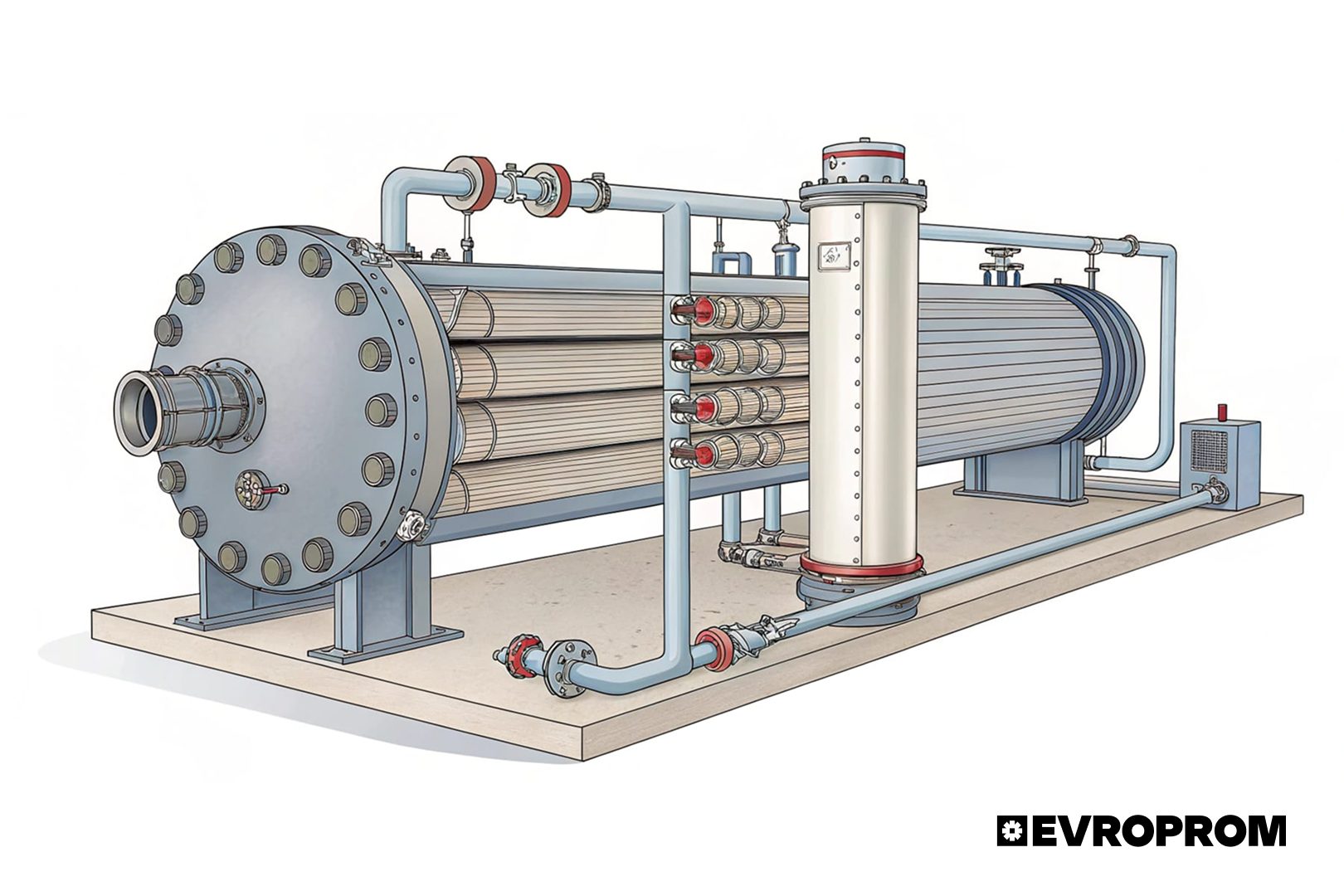
A shell-and-tube heat exchanger consists of a bundle of tubes inside a cylindrical shell. One medium flows through the tubes and the other medium flows around the tubes, which promotes heat transfer. In order to avoid deflection of the tubes when the ratio of tube length to tube diameter is large, support baffles are used in the shell of the heat exchanger.
Insider: In shell-and-tube heat exchangers with poor build quality, tube rubbing occurs where the tubes pass through the support baffle due to loose contact and the resulting vibration.
Advantages
- Designed for higher pressures and temperatures
- Suitable for handling contaminated fluids. Less susceptible to fouling than plate heat exchangers.
Disadvantages
- Bulky design, require more space for installation. As a consequence, the chiller also has a large size and weight.
- Less efficient than plate heat exchangers for small temperature differences.
- Difficult to maintain: Cleaning the tubes can be time-consuming.
Depending on the application, the shell and tube heat exchanger can have different connection configurations.
Shell and tube condenser
In a shell-and-tube condenser, superheated refrigerant vapours from the compressor are cooled to saturation temperature and condensed. In some cases, the resulting condensate is cooled below the condensation temperature (subcooled).
The intermediate coolant flows through the pipes and the refrigerant condenses on their outer surface. The lower part of the casing is usually not filled with pipes and can be used as a receiver for liquid refrigerant.

Figure 8. Flow diagram of media flow in a shell and tube condenser
Shell and tube evaporator
In the shell-and-tube evaporator, the liquid refrigerant boils, turning into vapour, which is sucked off by the compressor. The boiling of the refrigerant is carried out by heat extracted from the medium cooled in the evaporator. In shell-and-tube evaporators, the refrigerant can boil both inside the tubes and in the intertube space. A shell-and-tube evaporator in which the refrigerant boils in the intertube space and the coolant flows in the tubes is called a “flooded” evaporator. The main disadvantage of shell-and-tube evaporators of flooded type is the danger of freezing of the coolant in the pipes in case of its circulation stoppage, which can lead to pipe rupture.
For chillers of semi-industrial and commercial applications, the shell-and-tube evaporator with in-tube boiling of the refrigerant, which is devoid of this disadvantage, is more widespread.

Fig 9. Scheme of media flow in the shell-and-tube evaporator with in-line boiling of the refrigerating agent
Need help in selecting a heat exchanger or refrigeration system?
Contact our engineers for technical advice – we can help you find the best solution for your application. Also take a look at the catalogue of chillers and other climate control equipment on our website – up-to-date models, detailed specifications and individual approach to each customer.
Comparison
Which heat exchanger is right for your application? The choice between plate and shell and tube heat exchangers depends on your specific needs: Use a plate heat exchanger if you need high efficiency, compact design and easy maintenance for clean liquids. Use a shell-and-tube heat exchanger in high-pressure applications, for dirty fluids, or when durability is paramount. This is a short simple answer to a complex question. A large number of parameters need to be taken into account to decide whether to use one type of heat exchanger or another. A non-exhaustive list of factors for comparison is given in Table 1.
Table 1. Comparisons of shell and tube and plate heat exchangers
| Characteristics | Shell and tube heat exchangers | Plate heat exchangers |
| Heat transfer coefficient (relative) | 100% | 300-500% |
| Minimum required temperature of heat/cooling medium and refrigerating agent | 5-10°C | 1 – 2°C |
| Change of heat exchange surface area | Impossible | Permissible within a wide range, in multiples of the number of plates. (Provided that a collapsible heat exchanger is used) |
| Internal volume (relative) | 500- 00% | 100% |
| Accessibility for internal inspection and cleaning | Non-disassembled, difficult to access, simple replacement of parts not possible; only flushing possible | In case of disassembled MRO – easily accessible inspection, maintenance and replacement of any part, as well as mechanical plate flushing. |
| Disassembly time | 90 – 120 min. | 30 min (for disassembly) |
| Tube (plate) material | Brass, copper, stainless steel | Stainless steel, titanium |
| Seals | Non-disassembling. Simple replacement is not possible | Glueless seals can be easily exchanged for new ones. Rigidly fixed in the channels of the plate (for collapsible and semi-welded TVET) |
| Subject to corrosion at temperatures above 60 °C | Yes | No |
| Sensitivity to vibration | Sensitive | Not sensitive |
| Assembly weight (relative) | 1000 – 1500% | 100% |
| Service life before overhaul | 5 – 10 years | 4 – 6 years |
| Dimensions (relative) | 700 – 1000% | 100% |
| Cost (relative) | depending on purpose and connection scheme 50 – 100% | 100% |
Conclusions
Both plate and shell-and-tube heat exchangers offer distinct advantages. For industries where compact and efficient cooling is required, a plate heat exchanger chiller may be the ideal solution. On the other hand, a shell and tube chiller is better suited for applications where durability and the ability to handle dirty media and high pressures are important. Choosing the right heat exchanger will depend on factors such as fluid type, temperature range, space availability and maintenance needs.
If you still have questions about equipment selection, please contactEuropromspecialists. We will help you to choose the right solution and offer reliable chillers presented in our catalogue.

What you get with EVROPROM
Professional technical selection: we take into account the operating parameters, environment, operating conditions and system configuration – we offer the optimum solution for your specific application.
Engineering expertise and advice: we explain the prosandcons of each option in terms of reliability, maintenance, energy efficiency and service life.
A catalogue of proven equipment: a wide range of shell-and-tube and plate heat exchanger chillers from reliable manufacturers, adapted to industrial and commercial applications.
Reduced operational risks: with the right heat exchanger design, you minimise the chance of leaks, overheating, freezing or loss of efficiency.
Economies of ownership under control: optimise installation, maintenance and energy costs over the life of the equipment.

Author of the article:
Andrey Kohan, refrigeration engineer
29.08.2025