


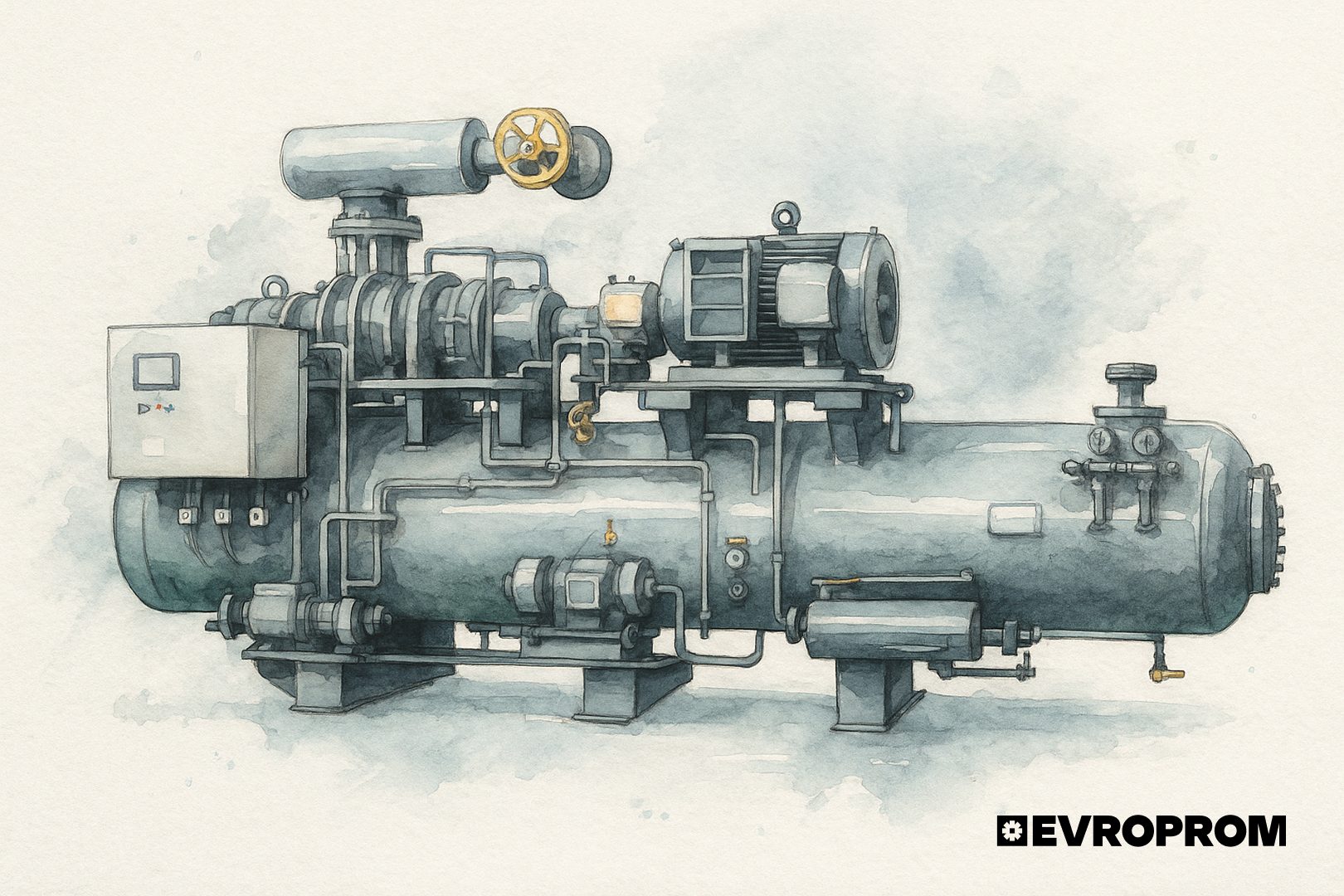
Calculation of a Chiller for Subzero Temperatures

Introduction
Application of chillers at low-temperature regimes (-15…-40 °C in terms of coolant temperature) is a highly specialised task and does not occur very often. In the majority of industrial refrigeration systems at such temperatures it is preferred to use systems with direct refrigerant boiling: evaporators working directly on the object being cooled, without an intermediate circuit. This is due to both the increased efficiency of the direct evaporation scheme and the simplification of the design.
Nevertheless, in a number of cases, the customer needs a solution based on an aggregated refrigeration machine with an intermediate coolant. Typical examples are pharmaceutical production and food processing, where separation of circuits, sanitary safety and temperature stability are required for long-distance cold transport.
Chiller operation at -15 … -40 °C makes a number of demands that are not present in “classic” machines designed for 7 … 12 °C water or glycol. The issues of correct refrigerant selection, reliable compressor operation, oil return, adaptation of the hydraulic system to viscous solutions and selection of materials resistant to aggressive media and low temperatures come to the fore. Every engineering decision here becomes critical: a bad choice can lead to chronic instability, frequent shutdowns or catastrophic loss of equipment life.
If you need help in selecting a chiller for your facility, contact EVROPROM engineers – we will find the optimal solution taking into account your wishes and operational peculiarities.
Temperature regime and its impact on efficiency
The main feature of low-temperature chillers is the need to organise the boiling of the refrigerant 5-10 °C below the required coolant temperature. If the system has to deliver -30 °C glycol to the consumer, the boiling point of the refrigerant will be in the range of -35…-40 °C. This inevitably leads to an increase in the specific compressor work and, as a consequence, to a decrease in the refrigeration coefficient of performance (COP).
Practice shows that every 1-2°C decrease in boiling temperature “costs” the machine 1.5-3 % of efficiency. In the -10 to -40 °C range, this translates into losses of tens of per cent compared to standard air-conditioning chillers. For this reason, such systems must be designed very carefully: any additional pressure drop in the evaporator or pipework is immediately converted into an increase in energy consumption.
In addition, as the boiling point decreases, the thermodynamic relationship between the condensing and evaporating temperatures deteriorates. For systems operating with 30 … 40 °C condensing, an increase in the temperature differential to 70-80 °C becomes a serious test for the compressor group. This is particularly sensitive for scroll and screw machines, which start to operate at the limit of their operating conditions.
Refrigerant selection for low-temperature chillers
Refrigerant selection is one of the key factors in designing a chiller for temperatures below -15 °C. A mistake at this stage will not only lead to a drop in efficiency, but also to problems with reliability, lubrication stability and compressor life.
In the classic “comfortable” for the chiller 0… 12 °C for the coolant – R134a, R410A or modern HFO blends are widely used. However, these refrigerants cannot operate in the low-temperature range: their thermodynamic characteristics and the range of permissible boiling temperatures do not allow to go below -15…-20 °C without critical pressure limitations.
R507 and R404A remain the most common in the range of -30…-40 °C. These mixtures (based on R125/R143a and R125/R143a/R134a respectively) are well developed in industry, provide stable boiling up to -40 °C, have acceptable specific cooling capacities. Their main disadvantage is high GWP (3900-4000), which makes their use long-term problematic in Europe and countries with strict environmental regulation.
In recent years, R448A and R449A have been actively introduced. These refrigerants are replacements for R404A/R507 with lower GWP (around 1400-1300) and are recommended by manufacturers such as Johnson Controls and Bitzer for low temperature applications. They have slightly higher operating pressures and reduced cooling capacity, which requires adjustment when selecting compressors and heat exchangers. Daikin and Trane, for their part, have officially dropped R404A from the specifications of new machines in favour of R448A/R449A.
The optimal choice of refrigerant depends on the balance:
- for “today’s” projects with the aim of 3-5 years of operation and without severe environmental restrictions, R404A/R507 remain appropriate;
- for long-term solutions or deliveries to Europe it is more appropriate to use R448A/R449A as a compromise in terms of efficiency and environmental friendliness;
- for ultra-low regimes (below -40 °C) it is necessary to switch to cascade schemes or special refrigerants (R23, blended HFO-HFC).
Lubricants and lubrication system
Chiller operation at low temperatures is directly dependent on the stability of the oil system. Whereas lubrication issues are secondary for standard machines operating in the 0…10 °C coolant range, at -30…-40 °C they become a key reliability factor.
POE (polyester) oils are almost always used for low temperature applications. Mineral and alkylbenzene oils lose their properties under such conditions – their viscosity becomes excessively high, recovery is impaired and, in the case of halogen-containing refrigerants, solubility is poor. POEs provide the necessary balance: on the one hand, they maintain sufficient fluidity at -40 °C, on the other hand, they dissolve well in refrigerants such as R404A, R507, R448A, which facilitates circulation and recovery.
The key problem at low temperatures is the oil viscosity drop due to the refrigerant dissolving in it. At the compressor inlet, where the pressure is low, some of the refrigerant actively mixes with the oil, reducing its lubricity. In practice, this means that at a boiling point of -35 °C, the actual viscosity can drop by 40-60 % relative to the nominal viscosity. This creates a risk of wear on bearings and piston groups.
Oil manufacturers (e.g. Emkarate RL, Suniso SL, Mobil EAL Arctic) always provide solubility and viscosity charts for specific refrigerants in their technical documentation. Ignoring these data during design leads to premature wear of the compressor already in the first 2-3 years of operation. Therefore, high efficiency oil separators (coalescent type) are almost always used in the refrigeration circuit of a low-temperature chiller. Screw compressors from Bitzer, Johnson Controls, Frascold are equipped with standard oil separators with filtration of 99 % of particles up to 0.3 microns in size.
Most failures of low-temperature chillers are related to the lubrication system: either oil starvation due to poor return, or destruction of oil viscosity at deep boiling conditions.
Contact us for professional advice and selection of a low temperature chiller for your application!
Compressor section and equipment selection
The compressor in a low-temperature chiller is the element that determines not only the stability of the entire system, but also its service life. At boiling temperatures of -30 … -40 °C, the compressor operates under extreme pressure differences and increased specific work, which places special demands on its design, lubrication and system solutions.
- Scroll compressors (Copeland, Danfoss, Mitsubishi Electric)
- Limited in discharge pressure and discharge gas temperature.
- Sensitive to oil return and overheating.
- In low-temperature chillers are more often used as a stage in cascade systems (e.g. upper stage on R134a, lower stage on R404A/R507).
- Screw compressors (Bitzer, Johnson Controls/Sabroe, Frascold, GEA)
-
- Most popular in the -15…-40 °C range.
- They have a wider working field and are resistant to large temperature differences.
- They can be equipped with additional liquid or steam injection systems for cooling and stabilisation.
- Trane and Johnson Controls chillers use screw compressors with an intermediate economiser to improve energy efficiency.
- For large boiling and condensing temperature ratios, two-stage compression screw compressors are used (Fig. 1)
- Piston compressors (Bock, Bitzer)
-
- Well-proven at low temperatures due to crisp operation with two-stage circuits.
- Can provide boiling down to -45 °C.
- They have capacity limitations: large systems are less frequently built than screw systems.
- More sensitive to oil quality and return.

Fig. 1 – Refrigeration aggregated machine with two-stage compression screw compressor
Two-stage and cascade schemes
Manufacturers such as Trane and Daikin explicitly state in their technical catalogues: for operation below -25 °C, it is necessary to change to screw or two-stage solutions.
At low boiling temperatures, compressors operate at high compression ratios, which leads to discharge temperatures of up to 100-120 °C. Without additional cooling systems, this leads to oil degradation and motor overheating (higher demands on oil filtration: any dirt or varnish build-up at these loads will quickly kill the bearings).

Fig. 2 – Aggregated cascade refrigeration machine
Two-stage compression with reciprocating compressors utilises intercooling of the gas, which reduces discharge temperatures and extends service life. At ultra-low temperatures (-45 °C and below), cascade chillers are often used, where one chiller operates on the upper range (e.g. R134a at -10 °C) and the second on the lower range (R23 or R404A at -40 °C). Figure 2 shows an example of such an aggregated chiller system.

Fig. 3 – Two-stage compression system

Fig. 4 – Cascade system
Take a look at our chiller catalogue – all units are thoroughly checked for defects, will be set to the correct temperature settings and shipped to you in perfect condition.
Additional elements of the refrigeration cycle
At low temperatures, technologies aimed at increasing the efficiency of the thermodynamic cycle are of particular importance. For example, chiller operation in the -20 … -40 °C range is impossible without special components and solutions that compensate for efficiency losses and increase equipment reliability. In low-temperature systems, every element of the cycle plays a critical role: while in “water” chillers (with a 7 °C supply) many options are considered secondary, in “deep minus” they become mandatory.
Economisers
An economiser is an intermediate vapour suction unit in the compressor (or in a separate stage) that allows:
- reduce the temperature of discharge gases,
- increase cooling capacity by 5-15%,
Bitzer OS catalogues explicitly state: when operating with R404A/R507 at -35 °C, the use of an economiser is mandatory.
Liquid and vapour injection
Injection systems are used to stabilise the compressor:
- Liquid injection – injection of supercooled liquid into the discharge zone. This prevents overheating and keeps the oil within the permissible temperature range.
- Vapour injection – injection ofvapour from the economiser into the interstage cavity of the screw compressor. The solution is more complex, but gives efficiency gains and reduces compression ratio.
These technologies are actively used in Daikin, Trane, Carrier machines for industrial low-temperature chillers.
Liquid subcoolers
Subcooling the liquid refrigerant upstream of the TRV is another way to increase efficiency. At low temperatures, even a small amount of additional subcooling (3-5 °C) significantly increases cooling capacity. A number of solutions utilise liquid-to-liquid plate heat exchangers as subcoolers.
Selection and preparation of the cooling medium
In low-temperature chillers, the coolant plays no less important a role than the refrigerant. In the range -15 … -40 °C, aqueous solutions of ethylene glycol, propylene glycol or salt solutions (CaCl₂, less frequently K₂CO₃) are most often used. The main selection criteria are freezing point, viscosity and compatibility with system materials.
Ethylene glycol has better thermal properties and low viscosity at sub-zero temperatures, but is toxic, so its use is limited to the food and pharmaceutical industries. Propylene glycol is more expensive and more viscous, but is safer and more commonly used where sanitary requirements are important. Calcium chloride solutions are low cost and have good heat capacity, but are corrosive to steel and require the use of corrosion inhibitors.
As the concentration of any coolant increases, the freezing point decreases, but at the same time the viscosity increases, which impairs circulation and increases the load on the pumps. For this reason, the optimum concentration is always selected with a reserve of 3-5 °C relative to the minimum operating temperature. In their technical recommendations, manufacturers specify the permissible concentration ranges and draw attention to the need for regular quality control of the solution, as degradation of the corrosion inhibitors over time reduces the reliability of the system.

Fig. 5 – Freezing point dependence on concentration for common coolants
In practice, mistakes with the coolant lead to a drop in efficiency of the entire plant more often than miscalculations in compressor selection. Excess viscosity at the wrong concentration can negate all efforts to optimise the refrigeration cycle.
Hydraulics
The hydraulic circuit of a low-temperature chiller faces increased loads due to the high viscosity of the coolant. Pumps must be selected to take account of the increased hydraulic resistance and cavitation risks. In practice, it is the circulation pumps that become the weak link in -30 to -40 °C operation if the change in fluid characteristics is not taken into account.
Particular attention is required for materials and seals. At low temperatures, elastomers lose flexibility and standard seals start to leak. Therefore, pump manufacturers (Grundfos, Wilo) recommend the use of special materials – EPDM or Viton for glycols, Teflon for aggressive salt solutions.
Expansion tanks should be designed for the reduced coefficient of thermal expansion of solutions compared to water and for the reduced ambient temperature in machine rooms. Underestimation of these factors leads to “floating” pressures and frequent activation of safety valves.
Furthermore, in systems with CaCl₂ and other salt solutions, the risk of crystallisation in pipes and heat exchangers during abnormal shutdowns must be taken into account. Proper thermal insulation and maintaining a minimum circulation in the circuit, even during downtimes, are important here.

Fig. 6 – Pumps operating under partial icing conditions
Conclusion
World manufacturers of chillers and components (Trane, Johnson Controls, Daikin, Bitzer) emphasise that the main condition for designing low temperature systems is strict consideration of equipment operating charts. Most failures are not due to “poor quality” components, but to compressors and pumps operating beyond their permitted operating limits.
In the manufacturers’ recommendations, special attention is paid to:
- selection of refrigerant, taking into account long-term availability and environmental constraints;
- the use of high-efficiency oil separators and lubrication control systems;
- mandatory crankcase heating and compressor soft start system;
- regular quality control of the coolant and maintenance of its concentration;
- use of economisers and liquid subcoolers at temperatures below -25 °C.
Practical experience shows that a low-temperature chiller is advisable where there is a need to distribute cold over several zones, transport it over long distances or ensure sanitary safety of processes. If the main objective is to minimise energy consumption, direct evaporation systems are preferable.
Working with low-temperature chillers requires more technical discipline in design and operation than with standard machines. Every engineering decision – selection of refrigerant, oil, coolant, pumps and additional cycle elements – has a direct impact on service life and reliability. An error in one detail can negate all efforts. Therefore, such installations are only justified when the customer recognises the trade-off between efficiency and safety, and is prepared to comply with the strict requirements of the equipment manufacturers.
If you still have questions about equipment selection, please contact Europrom specialists. We will help you to choose a suitable solution and offer reliable chillers presented in our catalogue.

What you get with EVROPROM
Optimal chiller selection for your tasks – we take into account operating modes, seasonal load fluctuations, reliability and energy efficiency requirements. We help you choose the optimal compressor type depending on the specifics of the facility.
Technical expertise and calculations – we provide energy efficiency comparisons (COP, EER), forecast operating costs, and calculate payback period for equipment replacement.
Up-to-dateand proven equipment – a wide range of chillers of world brands with different types of compressors and heat exchangers, adapted for industrial, commercial and infrastructure facilities.
Reduced operating costs – by using energy efficient solutions (turbo compressors, frequency control, optimised hydraulics) we reduce annual energy consumption and service costs.
Support at all stages – from the survey of existing systems and design to delivery, installation, commissioning and subsequent maintenance.

Author of the article:
Andrey Kohan, refrigeration equipment engineer
16.09.2025