


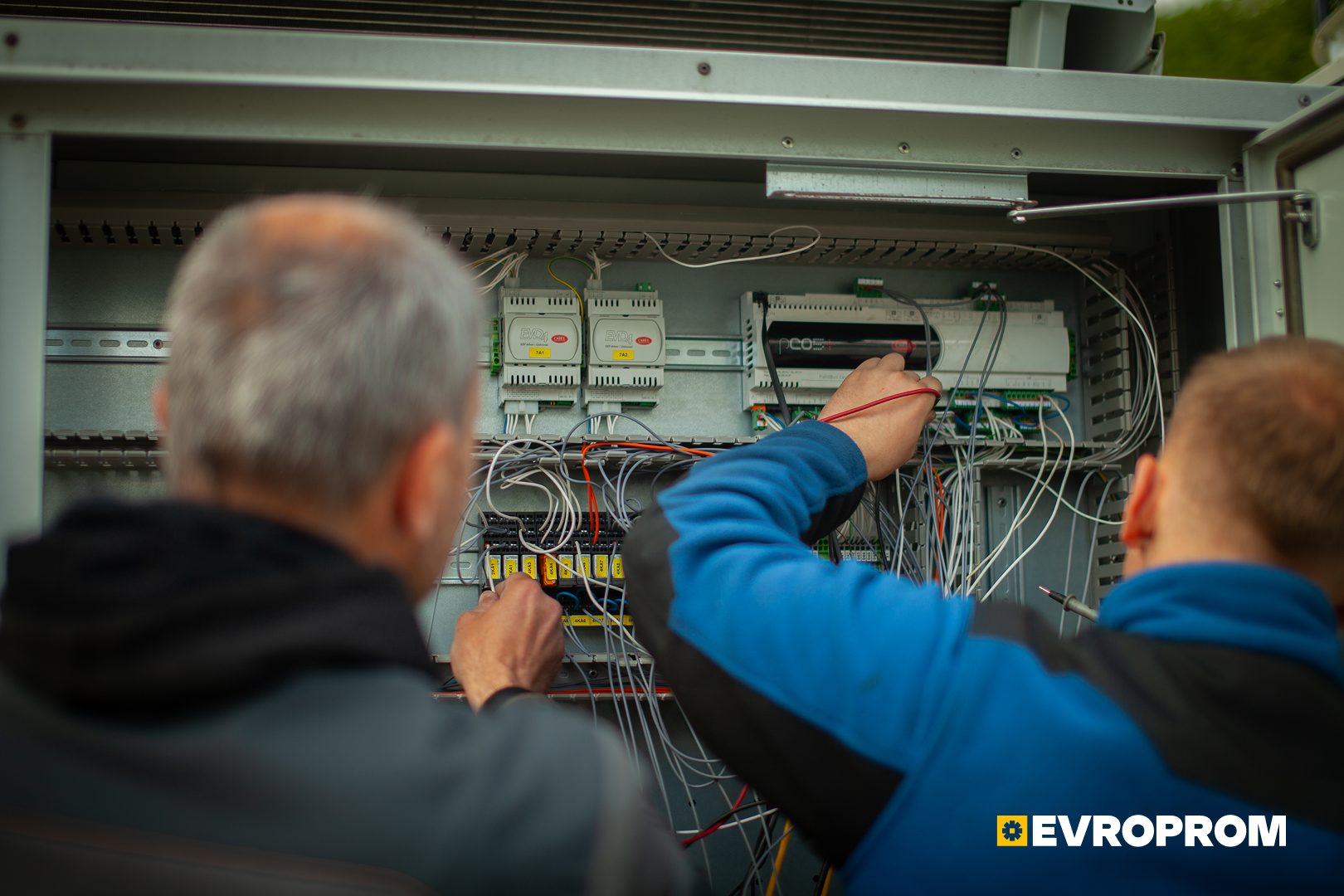
Electrical Chiller Options That Are “Rarely Ordered — but Should Be”

Introduction
When selecting a chiller, the customer’s attention is almost always focused on cooling capacity, compressor type and claimed energy efficiency, while the electrical part is perceived as secondary and “standard by default”. It is at this stage that questions arise as to whether it is worth paying extra for an advanced controller, communication interface, improved motor design or additional electrical options that at first glance do not directly affect COP or EER. Field experience shows that a large number of problems in real-life refrigeration machine operation are not related to the refrigeration circuit, but to the quality of the power supply, control logic and electrical design. This article looks at the electrical options that are most often discarded at purchase and why they are the ones that subsequently determine reliability, serviceability and actual cost of ownership.
Take a look at our catalogue of chillers and heat pumps –only proven models from reliable manufacturers, with full specifications and customisation for different applications.
Interface with BMS via digital protocol (Modbus, BACnet, etc.), in addition to dry contacts
The interface of the chiller with the BMS (Building Management System) via digital protocol (Modbus, BACnet, etc.) is a separate communication module or software option of the controller, through which dozens of technological and electrical parameters are transmitted to the outside: temperature, pressure, protection statuses, stage and frequency positions, power consumption, energy meters. In the basic configuration without this option the chiller, as a rule, gives outside only 2-4 discrete signals (“operation”, “alarm”, “attention”), i.e. without BMS it looks like a black box. Leading manufacturers explicitly distinguish such an interface as a separate option: for example, Trane has a BACnet Communication Interface module for units, installed in addition to the standard controller, and Daikin has a communication module or software option, without activation of which data points are simply unavailable over the network.

Fig. 1 – BMS capabilities: energy management, data visualisation, error handling and self-diagnosis, service planning
With a digital interface, the BMS receives not only the fact of an emergency stop, but also the specific cause, current and previous values of parameters, which reduces the diagnostic time from hours to tens of minutes and allows some incidents to be dealt with remotely, without travelling. In practice, this means less unplanned downtime, less “blind” replacement of components and the possibility of real monitoring of system energy consumption. The option starts to pay off after one or two complex incidents during the entire life cycle of the installation.
Energy efficiency class IE4 motors instead of IE3 motors
Compared to IE3, IE4 motors offer efficiency gains of around 1-2 percentage points in the standard power range for chiller pumps and fans (e.g. from 94-95 % to 96-97 % for 30-75 kW motors). At first glance, the difference does not seem significant, but in the energy balance it means a reduction in the motor’s own losses of around 15 to 25 per cent. For circulating pumps and condenser fans with an annual operating time of 3000-5000 hours, the savings amount to hundreds of kilowatt-hours per year per drive, while at the same time the operating temperature of the windings and the load on the motor cooling system are reduced. At the same time, operation under non-ideal supply conditions (phase misalignment, voltage drop) for the more efficient motor is accompanied by lower overheating and, consequently, slower ageing of the insulation.

Fig. 2 – Comparison of motor efficiency by energy efficiency class

Fig. 3 – Increase in efficiency of electric motors and average selling price
For the customer, the surcharge for the IE4 version is usually a few per cent of the chiller price, but is then spread over the lifetime of the unit and is particularly noticeable in facilities with year-round operation. When considering energy efficiency alone, at industrial customer rates and a total installed capacity of pumps and fans of around 30-60 kW, the difference between IE3 and IE4 gives a payback period of a few years, after which the reduction in energy costs works to the advantage. In addition, the choice in favour of IE4 gives an electrical reserve for temperature and losses, which increases the survivability of the motor when operating with a frequency converter and in networks with distorted voltages. Together, this makes a motor with a higher energy efficiency class not only a means of saving energy, but also a factor in increasing the reliability of electric drives.
If you need help with your refrigeration equipment selection, please contact our experts for technical advice and a professional selection for your application.
Low-temperature kit for operation at low outdoor temperatures (condensing pressure control, “winter” mode)
The low-temperature kit for air chillers is a set of electrical and algorithmic solutions to maintain stable operation at reduced outdoor temperatures, typically below the standard operating range (typically from ≈ 5 … 7 °C to -15 … -20 °C, depending on the series). In the basic version, condensing pressure control is either missing or roughly implemented: the fans are switched on in steps according to the pressure sensor signal, which at low temperatures leads to pressure sawing, frequent stops due to low boiling pressure, unstable operation of the TRV and increased number of compressor starts. The low-temperature package includes more precise fan control (frequency or multi-speed), additional sensors, sometimes bypass devices and adapted setpoints to keep the condensing pressure within a narrow range when the outside air is well below 10 °C.
For the customer, paying extra for such a set is usually perceived as excessive, especially if the project does not clearly specify the modes of off-season and winter operation. However, from the point of view of operation, the difference is fundamental: a chiller without a low-temperature kit at outdoor temperatures of about 0 °C and below often goes into modes with 5-10 or more compressor starts per hour, unstable overheating and regular shutdowns due to accidents, whereas a unit with this kit is able to operate continuously with a limited number of starts and stable condensing parameters. In facilities where year-round cooling is required (server rooms, technological processes), this kit actually turns from an “option” into a condition for normal system operation, reducing both operational risks and the total wear and tear of the compressor and electrical parts.
Compressor crankcase heating in reinforced/reserved version with temperature control and start-up lockout
Compressor crankcase heating prevents the migration of refrigerant into the oil during shutdowns and, as a result, foaming and water hammer during start-up. In the basic configuration, a single heater is usually used without monitoring the actual oil temperature and without redundancy, with a simple timing condition: a 2-4 hour delay before the first start-up after power supply. If such a heater fails, the compressor may start at an oil temperature that differs from the refrigerant saturation temperature by less than 5-10 °C, resulting in a significant liquid refrigerant content in the crankcase. At the moment of start-up this is manifested by short-term increase of pressure and currents, deterioration of lubrication regime and accelerated wear of bearings and friction surfaces, especially on screw machines.

Fig. 4 – Example of outdoor compressor heating design
The advanced crankcase heating option includes either two heaters per circuit with independent control or more powerful heating with oil temperature monitoring and start-up prohibition in case of underheating. The setpoints are set at 10-20°C of crankcase temperature exceeding the saturation temperature, calculated from the pressure in the circuit, with mandatory start interlock if this condition is violated, or simply at 45°C. For the customer this looks like a small increase in cost, but in the operational horizon it reduces the likelihood of compressor damage after long stoppages and power interruptions, especially in cold rooms. A single “failed” start-up with oil saturated with refrigerant can cause tens of thousands of dollars worth of damage to a unit, while enhanced crankcase heating remains a typical low-cost option that significantly reduces this risk.
Control cabinet version with heating, condensation protection and increased protection of the enclosure
The chiller control cabinet with heating and increased enclosure protection is designed to ensure stable operating conditions for the power and control electronics when used outdoors or in areas with high humidity. In the basic version, the enclosure is IP54, installed without an internal heater and designed for an ambient temperature close to comfortable. Temperature fluctuations and moisture inside the cabinet cause condensation, which leads to corrosion of terminals, current leakage on boards, chaotic I/O failures and premature failure of contactors and circuit breakers. In practice, several “day/night” cycles with a temperature difference of 10-15 °C and high relative humidity are enough to cause moisture to consistently appear inside the cabinet in cold areas.

Fig. 5 – Example of condensation in a control panel
The advanced version provides for the installation of a thermostatically controlled cabinet heater with a capacity of about 50-150 W, the use of glands and seals corresponding to a higher degree of protection (IP55-IP65), and sometimes paint or lacquer coating of boards and busbars. The heating keeps the internal temperature 3-5 °C above the dew point, thus preventing the formation of condensation on current-carrying and contact surfaces. For the customer, this adds a small permanent power consumption and a small increase in the cost of the enclosure, but in the long term it dramatically reduces the number of hard-to-interpret electrical failures related to moisture and corrosion. In combination with the correct organisation of ventilation and cable routing, this design is particularly justified for units operating outdoors and in areas with high humidity, where climatic influences have a dominant influence on the life of the electrical part.
Extended set of power supply protections: phase and voltage monitoring, overvoltage limiters, correct selectivity of circuit breakers
In the basic version, a chiller usually has an input circuit breaker, sometimes a simple phase control relay and the standard protections of the frequency converters themselves. An extended set of supply protection includes additionally specialised voltage quality, phase unbalance and overvoltage monitoring devices, as well as a properly selected hierarchy of circuit breakers with selectivity. Usually, phase and voltage control relays with a window of, for example, 0.9-1.1 of the nominal voltage (360-440 V for a 400 V network), an allowable phase misbalance of no more than 2-3 % and a time delay of 2-10 seconds, as well as class II-III overvoltage arresters with a discharge capacity of 20-40 kA per pole are used. Such scheme allows to switch off the unit in case of unstable power supply before the inputs of frequency converters and power supply units receive pulses or long deviations leading to varistors breakdown, rectifiers overheating and insulation destruction.
For the customer, the additional payment for the extended set of protections looks moderate compared to the cost of the unit and, as a rule, is a few per cent of the chiller price, but in the operational horizon it is directly converted into a reduction in the number of failures of power electronics and non-obvious “electrical” accidents. In the absence of phase and overvoltage control, the unit continues to operate with failures up to 320-340 V on one of the phases, with lightning or switching impulses and with inadequate network frequency settings, and the consequences manifest themselves at the level of failure of frequency converters, controllers and contactors. The presence of network monitoring relays, surge arresters and properly selected selectivity of circuit breakers translates most of these events into controlled tripping on the upper level of protection, with subsequent normal restart without damage to internal components, which reduces both direct repair costs and indirect losses from plant downtime.
Conclusion
Taken together, the options considered do not change the chiller’s nameplate cooling capacity and are hardly reflected in advertising materials, but they determine whether the unit in real operation will “work according to the nameplate” or systematically exceed the design conditions. Digital interface with BMS, controller with archives and trends, motors of higher energy efficiency class, low-temperature set, reinforced crankcase heating and climatically correct design of control cabinet form the electrical infrastructure that allows the refrigeration circuit to realise its resource without chronic failures and unjustified downtime. For the customer, this means that a small additional payment at the purchase stage for the correct electrical equipment often has a greater effect on reliability and total cost of ownership than trying to save money on “invisible” options with unchanged COP and EER values in the catalogue.
If you still have questions about OUTLET or new equipment selection, please contact Europromspecialists. We will help you to choose a suitable solution and offer reliable chillers presented in our catalogue.

What you get with EVROPROM
Optimal chiller selection for your tasks – we take into account operating modes, seasonal load fluctuations, reliability and energy efficiency requirements. We help you choose the optimal compressor type depending on the specifics of the facility.
Technical expertise and calculations – we provide energy efficiency comparisons (COP, EER), forecast operating costs, and calculate payback period for equipment replacement.
Up-to-dateand proven equipment – a wide range of chillers of world brands with different types of compressors and heat exchangers, adapted for industrial, commercial and infrastructure facilities.
Reduced operating costs – by using energy efficient solutions (turbo compressors, frequency control, optimised hydraulics) we reduce annual energy consumption and service costs.
Support at all stages – from the survey of existing systems and design to delivery, installation, commissioning and subsequent maintenance.

Author of the article:
Sergey Klitschko, Electronics Technician
23.12.2025