


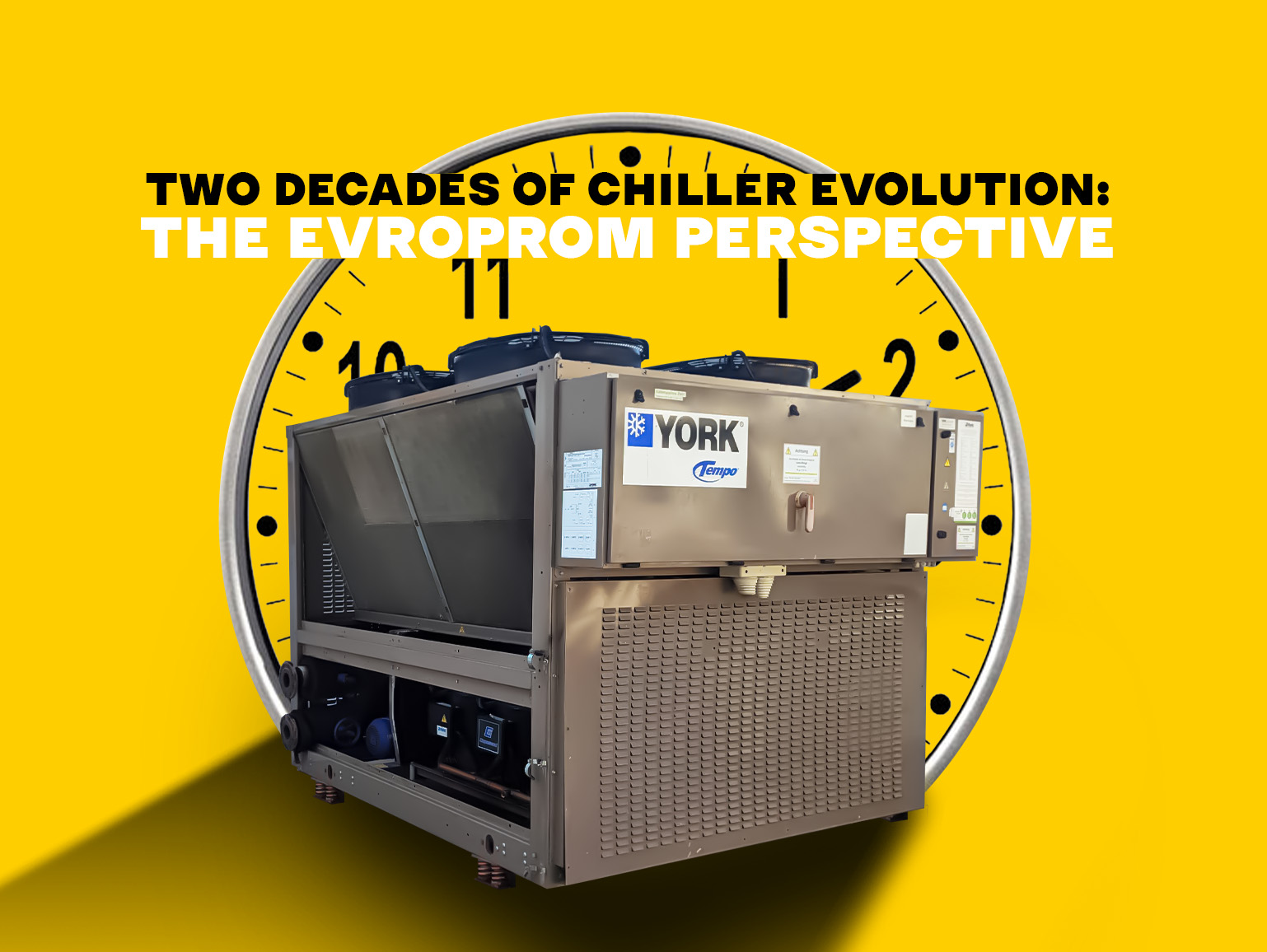
Two Decades of Chiller Evolution: The Evroprom Perspective
Looking back on a journey through nine years of accumulated experience, Evroprom shares insights into the changing landscape of chillers, advocating for the significance of dealing in old-school units. This discourse bypasses the realm of second-hand chillers that have served a year or two, delving instead into machines crafted 15 to 20 years ago.
Evroprom’s warehouse boasts around 200 chillers, witnessing an array of refrigeration technologies passing through its hands over the years. Every brand ever was made – Evroprom has seen them all. From rusted five-year-old chillers to machines from 1996 that still shine like new, Evroprom is well-acquainted with the diverse outcomes of varying maintenance practices.


The richness of Evroprom’s experience extends beyond borders, observing chillers from different corners of Europe. Each region, with its unique people and mentalities, contributes to the diversity of the chillers encountered. Evroprom acknowledges the substantial differences between chillers originating from France, Germany, and Britain.
Before dismissing these insights, it’s crucial to note that every second-hand chiller sold by Evroprom in the last nine years continues to operate, backed by our reputation. A shining example is the TRANE ERTAA 1996 chiller in Lutsk, faithfully cooling an ice rink for eight years.
We hear lots of concerns about the quality of new equipment and a growing inclination towards used machines from major companies. For instance, Trane has expressed intentions to repurchase their old units, and clients visiting our warehouse about the significant differences in the performance of new machines compared to their predecessors.
However, we don’t attribute these challenges to manufacturers alone. The burdens of bureaucracy and policymakers implementing new laws without understanding the essence of the technology plague the industry. This simplification trend echoes across sectors globally, from aviation comfort to the durability of recycled material-based cars.
How do chillers fit into this narrative?
In the last two years, Evroprom has replaced around 100 microchannel condensers. Environmental measures and new certification standards demand the sacrifice of equipment longevity for the integration of innovative technologies. Selling a microchannel chiller to clients in regions where summer temperatures soar above +45 degrees Celsius is a daunting task.
Consider the number of compressors in a chiller. A Lennox (Refac) chiller from 1999, boasting 200 kW, featured six Danfoss scroll compressors. Today, it’s fortunate if a chiller has four.
The copper era has faded away!

What about the quality of components? Let’s look at copper pipes. As you know, they are used in shell-and-tube heat exchangers and condensers, and freon lines are also made from them. As the proverb says: Where it is thin, it breaks. But apparently manufacturers ignore this fact. From year to year, the thickness of copper pipes diminishes rapidly, leading to more frequent leaks. Few more years, we will be able to make a hole in a copper pipe with a finger.
Quality of painting and metal thickness.

As I’ve mentioned before, we’ve observed chillers of various ages. I can confidently state that the newer the chiller, the thinner the layers of paint and the thickness of the metal. Otherwise, how else can we explain the disappearance of 3 tons of weight on a 1300 kW chiller?
Once, my grandmother recounted seeing Climaveneta chillers whose bodies and lids were made of stainless steel, with an aluminum profile around the perimeter. The Climaveneta logo was embedded in each corner of the profile. That’s something!
Hardware (bolts, hinges)

Cheap, cheaper, even cheaper! What do you think they are cutting costs on? Yes, on everything! I was amazed when I saw the difference in the same model after 9 years. Bolts were replaced with screws, the lids became lighter, and disassembling and reassembling the chiller now seems frightening because it looks like it’s meant for one-time use. However, it’s energy-efficient but not durable.
Progress!
The saying goes, “The fancier the jeep, the farther you go for a tractor!” Viktor Sirota, our esteemed electromechanic at Evroprom, stands as one of the finest specialists in his field. Frequently, he offers recommendations on how manufacturers could enhance a chiller component to ensure smooth operation and minimize glitches. Unfortunately, these valuable suggestions, laden with profanity, cannot be adequately translated into the nuances of the Italian language.
Nevertheless, I cannot help but agree with Viktor. His words strongly resonate with a tale from the book, “Taking Risks with One’s Own Skin.” We at Evroprom consistently implement what we preach when offering a 12-month warranty on chillers equipped with more sensors than bolts.
The golden rule, as per the book, asserts that the more complex a system, the higher the likelihood of it malfunctioning. With a multitude of interconnected functions in a chiller, routed through a single control unit, the probability of a system failure and the subsequent shutdown of the entire chiller escalates.
In conclusion, I extend heartfelt gratitude to all manufacturers and individuals devoted to the creation of chillers, those who are passionate about their product and craft. Without your dedication, we wouldn’t be where we are today.
As for the choice between new or used equipment, the decision lies entirely with each individual. Everyone must weigh the benefits of advanced features against the potential drawbacks of increased complexity.
