


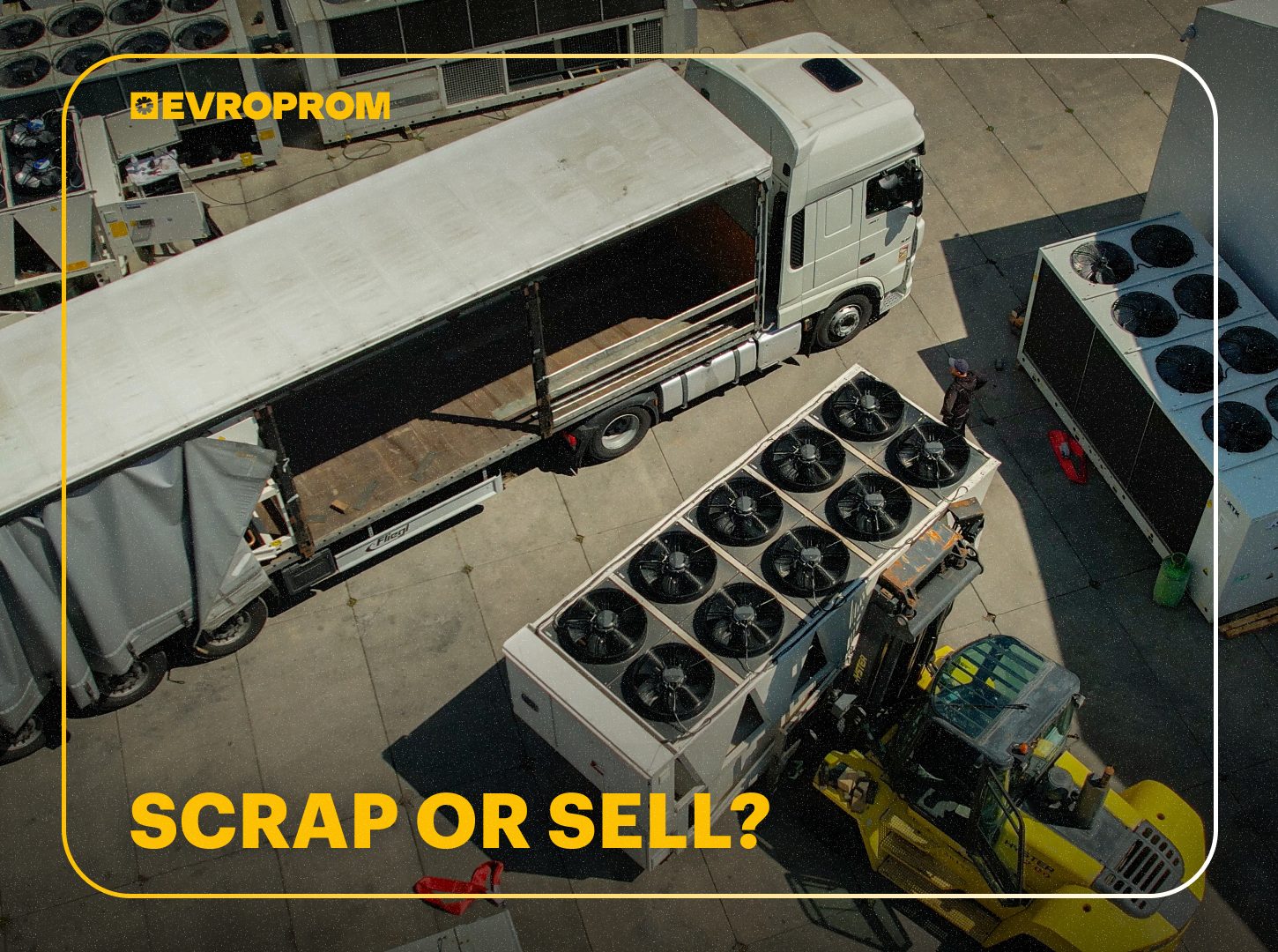
What to Do with a Chiller: Scrap or Sell? Certified Refrigerant Disposal

Each year, over 150,000 industrial chillers are decommissioned across Europe. Many companies scrap these units without considering the environmental impact:
-
Release of greenhouse gases (refrigerants)
-
Soil and water contamination by oils
-
Toxic waste from electronics and plastics
-
Loss of valuable resources (energy, materials, production input)
Legal Context:
European legislation (EU Regulation No. 517/2014 and WEEE Directive 2012/19/EU) mandates strict disposal procedures.
Why Uncontrolled Disposal Is Dangerous:
An industrial chiller is not just “a box filled with refrigerant.” It’s a complex system that includes:
-
Refrigerants (typically R410A, R407C, R134a, R32, etc.)
-
Compressor oils (mineral, synthetic, PAO, etc.)
-
Copper and aluminum heat exchangers
-
Steel and non-ferrous metals
-
Insulating materials (polyurethane foam, polystyrene)
-
Electronic components (PCBs, sensors, wiring, power modules)
-
Plastics
Each of these components presents unique environmental risks when improperly discarded.
Key Environmental Risks
1. Refrigerant — the Invisible Threat
The primary greenhouse gas hazard comes from refrigerants.
Global Warming Potential (GWP):
| Refrigerant | GWP (CO₂ equivalent) |
|---|---|
| R410A | 2088 |
| R134a | 1430 |
| R407C | 1774 |
| R32 | 675 |
Practical example:
1 kg of leaked R410A = 2088 kg of CO₂ released into the atmosphere — equivalent to driving a diesel car for ~15,000 km.
Improper refrigerant removal guarantees release into the environment.
2. Oils — Soil and Water Contaminants
Compressor oils — even “biodegradable” ones — can:
-
Disrupt water oxygen balance
-
Harm microbial ecosystems
-
Persist in the environment for 5–15 years
Regulations (WEEE Directive & EC Regulation 1013/2006) require complete extraction and certified disposal by licensed operators.
3. Electronics and Insulation
Control boards and power modules contain:
-
Lead
-
Cadmium
-
Brominated flame retardants
-
Mercury-based components
Insulating materials release fine plastic particulates during incineration or degradation.
Burning 1 ton of plastic insulation = 2+ tons of CO₂ + toxic gases.
4. Resource Waste
Each chiller represents major manufacturing input:
-
Electricity for metal processing
-
Heat exchanger fabrication
-
Complex electronics production
According to the IIAR (International Institute of Ammonia Refrigeration), a new chiller (~350–500 kW) emits up to 20–25 tons CO₂-eq. during production.
Refurbishment saves up to 80–90% of those inputs.
Conclusion (Midpoint):
Scrapping a chiller without proper disposal:
-
Releases CO₂ via refrigerants
-
Contaminates soil and water via oils
-
Leaves toxic electronic and plastic residues
-
Wastes decades of industrial effort and resources
How EVROPROM Handles Refrigerant Disposal:
We strictly follow European regulations.
Before disposal or dismantling:
-
All refrigerant is extracted using specialized recovery systems
-
Gas is collected in certified cylinders
-
System pressure is checked to confirm full removal
The refrigerant is then transferred to a licensed facility for:
-
Recovery and reuse (if possible), or
-
Thermal plasma destruction
We provide an official refrigerant disposal certificate upon request — suitable for internal audits or compliance with ISO 14001 or CSR reporting.
Why Proper Disposal Matters:
Neglecting refrigerant recovery can result in:
-
Fines up to €200,000 in some EU countries (e.g., Germany, Netherlands)
-
Violation of environmental standards
-
Significant climate impact
Proper Disposal — Step-by-Step:
-
Refrigerant Extraction:
-
Use of dedicated recovery units
-
Certificate required for reporting
-
-
Oil Removal and Handover:
-
Draining oils for licensed processing
-
Separate documentation needed
-
-
Dismantling and Material Sorting:
-
Manual disassembly of heat exchangers, compressors, condensers
-
Separate disposal streams for metals, plastics, electronics
-
-
Documentation and Decommissioning Records:
-
Full audit trail for environmental compliance
-
Certificates and protocols for each stage
-
Proper disposal is complex, resource-intensive, and often costly.
The Alternative: Sell Your Chiller
Instead of bearing disposal costs, you can sell your chiller.
Benefits for Your Business:
-
No removal or disposal expenses
-
Recover part of your investment
-
Environmentally responsible reuse
-
Fast, simple transaction with full documentation

Why Sell to EVROPROM?
EVROPROM is Europe’s largest refurbishment and resale center for used and outlet chillers.
✔️ Professional Evaluation
Based on condition, specs, and configuration.
✔️ Certified Refrigerant Disposal
We handle all required paperwork for non-restorable units.
✔️ Quick Dismantling & Pickup
Turnkey logistics by our team.
✔️ Financial Efficiency
Transparent terms, prompt payment.
✔️ Documentation Support
Full set of documents for accounting and compliance.
How to Sell Your Chiller to EVROPROM — 4 Simple Steps:
-
Contact Us
Share basic unit info: model, brand, year, condition -
Receive Preliminary Quote
Fast market valuation from our team -
Confirm the Terms
We align on all logistics and paperwork -
Dismantling & Transport
We handle everything, professionally and quickly

EVROPROM helps businesses make smart decisions.
Selling your chiller is not only a smart financial move — it’s also an environmentally responsible one.

Author of the article:
Iryna Bilokon, Head of Procurement Department
June 18, 2025