


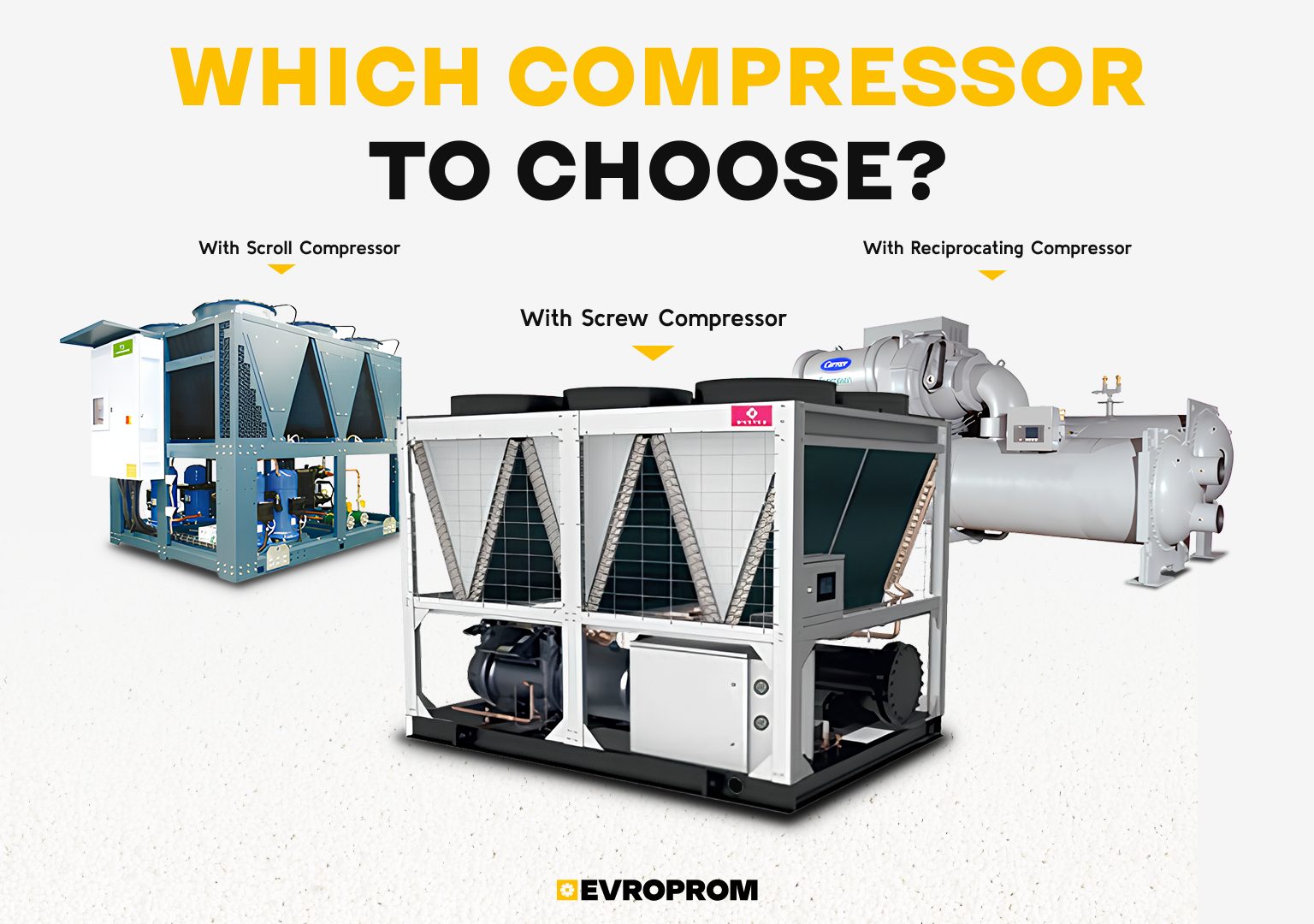
Comparison of Chiller Compressors: Technical Selection Criteria and Application Areas

Comparison of Chiller Compressors: Technical Selection Criteria and Application Areas
In the context of increasing demands for energy efficiency and reliability of refrigeration systems, the proper selection of a compressor becomes a key factor in choosing a chiller. This article is intended for engineers, designers, and operations specialists who aim to make technically sound decisions when selecting refrigeration equipment.
Here, you will find a detailed comparison of the three main types of compressors — reciprocating, screw, and scroll — evaluated by their operating modes, cooling capacities, performance characteristics, and total cost of ownership. The article presents a comparative analysis of technical specifications, operating parameters, and economic factors that influence compressor selection depending on the application conditions.
The analysis focuses on mass-produced units, excluding custom-designed chillers tailored for specific projects. Therefore, the main task is a correct evaluation of operating conditions and an informed compressor choice from the standard product line.
Compressor Types under Consideration
For use in integrated refrigeration systems (chillers), the most common types of compressors are:
Note: The photos show chillers equipped with both air-cooled and water-cooled condensers — so you don’t get the impression that a chiller is just a “box” with fans.
Reciprocating Compressors
Reciprocating Compressors (Figs. 1, 2) — feature a simple design, high serviceability, and operation across a wide temperature range. Some maintenance tasks can be performed by in-house personnel.
Key disadvantages: elevated noise and vibration levels.

Fig. 1 – Chiller with reciprocating compressors and air-cooled condenser

Fig. 2 – Chiller with reciprocating compressors and water-cooled condenser
Screw Compressors
(Figs. 3, 4) — offer high capacity, smooth operation, and excellent energy efficiency, especially in medium- and large-capacity chillers.
Compared to reciprocating compressors, screw compressors are more compact and quieter, but they have a more complex design and require qualified service.

Fig. 3 – Chiller with screw compressor and air-cooled condenser

Fig. 4 – Chiller with screw compressors and water-cooled condenser
Scroll Compressors
(Figs. 5, 6) — deliver low noise levels, high efficiency, and compact dimensions, making them well-suited for low- to mid-capacity chillers.
Scroll compressors are less reliable under low temperature and high-load conditions, and their repairability is limited.

Fig. 5 – Chiller with scroll compressors and air-cooled condenser

Fig. 6 – Chiller with scroll compressors and water-cooled condenser
Compressor Selection Based on Operating Mode
Let’s start with the basic technical parameters — namely, the required condensation and evaporation temperatures. As a reference point, the most common application is chilled fluid preparation (water), with a supply temperature of +6 °C and return at +12 °C. The evaporation temperature depends on the type of evaporator and is typically 1–8 °C lower than the chilled fluid supply temperature (1–3 °C for plate and brazed plate heat exchangers; 5–8 °C for shell-and-tube heat exchangers).
For air-cooled chillers operating in ambient temperatures up to 35 °C, we can assume a design condensation temperature of 45 °C. For water-cooled systems, this value typically does not exceed 35 °C.
Refer to Table 1 to select the compressor type suitable for the specified operating mode. In our example — +2 °C evaporation / +45 °C condensation — all three compressor types are potentially suitable. To make a final decision, it is advisable to verify the exact operating range in the technical documentation of the specific compressor model.
It’s also worth noting that when using water as a secondary coolant, it’s best to avoid the risk of freezing the evaporator. To reduce this risk, consider setting the evaporation temperature to at least +1 to +2 °C.
Table 1. Operating Ranges for Compressor Types
| Condensing Temp (°C) | Evaporating Temp (°C) | Reciprocating Compressor | Screw Compressor | Scroll Compressor |
| 35 | 2 | ✔️ | ✔️ | ✔️ |
| 35 | –3 | ✔️ | ✔️ | ✔️ (limited) |
| 35 | –8 | ✔️ | ✔️ | ❌ |
| 35 | –13 | ✔️ | ✔️ | ❌ |
| 40 | 2 | ✔️ | ✔️ | ✔️ |
| 40 | –3 | ✔️ | ✔️ | ✔️ (limited) |
| 40 | –8 | ✔️ | ✔️ | ❌ |
| 40 | –13 | ✔️ | ✔️ | ❌ |
| 45 | 2 | ✔️ | ✔️ | ✔️ |
| 45 | –3 | ✔️ | ✔️ | ✔️ (limited) |
| 45 | –8 | ✔️ | ✔️ | ❌ |
| 45 | –13 | ✔️ | ✔️ | ❌ |
| 50 | 2 | ✔️ (limited) | ✔️ | ✔️ (limited) |
| 50 | –3 | ✔️ (limited) | ✔️ | ❌ |
| 50 | –8 | ✔️ (limited) | ✔️ | ❌ |
| 50 | –13 | ✔️ (limited) | ✔️ | ❌ |
Compressor Selection Based on Cooling Capacity
Selecting a compressor type based on cooling capacity is generally advisory in nature and guided more by common sense than strict rules. After all, why install 20 scroll compressors when the same capacity can be achieved with just two screw compressors?
At this stage, it’s also essential to consider redundancy in cooling capacity. If your chiller relies on a single compressor to deliver 100% of the required cooling output, a failure will result in the complete loss of cooling.
Depending on the criticality of the process, it may be reasonable to divide the cooling load between two or three compressors, regardless of type. In high-risk or high-value processes — where the potential cost of lost product far exceeds the cost of equipment — redundancy schemes such as 100% + 50% or even 100% + 100% are often used.
Table 2. Recommended Compressor Type by Required Cooling Capacity
| Cooling Capacity | Recommended Compressor Type | Comments |
| 1 – 50 kW | Scroll, Reciprocating | Scroll units are optimal for small capacity and low noise; reciprocating are versatile. |
| 50 – 100 kW | Scroll, Reciprocating | Scroll remains efficient; reciprocating suits tougher operating conditions. |
| 100 – 200 kW | Scroll, Reciprocating, Screw | Scroll can still be used depending on conditions; screw becomes more economical at upper range. |
| 200 – 300 kW | Screw, Reciprocating | Screw preferred for energy efficiency and smooth capacity control. |
| 300 – 500 kW | Screw | Screw units offer high capacity and reliability in this range. |
| 500 kW and above | Screw | Screw compressors are the only effective solution at this scale. |
Selection Based on Operational Characteristics
Now let’s move on to analyzing the operational features of different compressor types. In the previous two sections, you may have noticed that all three types of compressors overlap in terms of application areas. So, when other parameters such as operating mode, environmental conditions, and system configuration are equal, we can compare their ownership and maintenance aspects.
The data below is averaged, but this comparison provides a well-rounded understanding of what to expect in terms of compressor operation.
Table 3. Average Operational Characteristics of Compressors
| Parameter | Reciprocating Compressor | Screw Compressor | Scroll Compressor |
| Planned Maintenance Schedule | 5,000 hours – oil inspection/replacement;
3,000 – 18,000 hours – rings, valves, bearings |
5,000 hours – oil inspection;
5,000 – 50,000 hours – clearances, seals, bearings |
No repair – usually replaced as a whole |
| Key Replacement Parts | Rings, valves, pistons, oil, filters | Bearings, seals, gaskets, oil | Entire compressor unit |
| Common Failures | Wear of rings, bushings, valves; oil leakage; clogged oil filter | Bearing wear, seal failures, oil filter clogging, loosening of gaskets | Spiral wear |
| Repair Time (if parts in stock) | 2–3 days | 5–7 days | 1–3 days (replacement) |
| Repair Complexity | High repairability, parts widely available | Complex repair, special service required | Typically replaced entirely |
| Typical Service Life | 15 years | 15–20 years | 5–7 years |
| Cost of Planned Maintenance | 5–10% of compressor cost | 7–12% of compressor cost |
— |
| Cost of Overhaul | 30–50% of compressor cost | 40–60% of compressor cost | 70–100% (replacement required) |
Compressor Selection Based on Total Cost of Ownership (TCO)
When evaluating compressor operation efficiency, a key factor is the total cost of ownership, which includes capital investment, maintenance, repair, and energy consumption. The ranges shown in Table 4 reflect approximate average figures and may vary depending on specific models and operating conditions.
Table 4. Economic Indicators of Compressor Types
| Parameter | Reciprocating Compressor | Screw Compressor | Scroll Compressor |
| Relative cost per 1 kW of installed cooling capacity | 100% (baseline) | ~150–200% | ~80-120% |
| Maintenance costs over 10 years (% of compressor price) | ~170% | ~120% | ~200% |
| Relative energy consumption | 100% (baseline) | ~90…95% | ~90…95% |
| Total cost of ownership over 10 years (purchase + maintenance + electricity), % of compressor price | ~3500% | ~3200% | ~3600% |
Typical Decision-Making Scenarios
To help apply the data from the previous sections, here are several typical compressor selection scenarios based on specific business objectives and operating conditions. For a tailored solution considering your production requirements and cooling specifications, feel free to consult our specialists.
Scenario 1: Minimum Capital Investment with Short-Term Payback
Objective: Launch production with a limited budget for refrigeration equipment.
Technical Conditions: Capacity up to 100 kW, standard temperature ranges (evaporation +1…+5 °C, condensation up to 45 °C), intermittent operation.
Solution: Scroll compressors offer the lowest cost per kilowatt of installed capacity compared to reciprocating and screw units. Plan for replacement after 4–5 years of service.
Limitations: Applicable only if evaporation temperature is not below –3 °C; limited serviceability, no major overhaul options.
Scenario 2: Continuous Production with High Reliability Requirements
Objective: Ensure 24/7 operation of process equipment without downtime.
Technical Conditions: Capacity above 200 kW, variable load profiles, wide range of condensing temperatures, energy efficiency required.
Solution: Screw compressors with stepless capacity modulation from 30–100%. Power consumption is ~10% lower than reciprocating compressors under comparable conditions. Overhaul intervals of 10,000–20,000 hours ensure uninterrupted operation.
Technical Rationale: Screw compressors operate without valves — eliminating the most common failure point in reciprocating units. Oil cooling reduces discharge temperature and extends lifespan.
Scenario 3: Universal Solution with Focus on Maintainability
Objective: Operate and maintain equipment in-house without external service providers.
Technical Conditions: Capacity between 50–200 kW, in-house technicians of intermediate qualification, standard operating conditions.
Solution: Reciprocating compressors allow for staged repairs and part replacements (valve plates, rings, bearings).
Advantages: Spare parts readily available, pressure and temperature diagnostics possible, repairs manageable by on-site personnel.
Conclusion
The choice of compressor type should be based on a priority matrix:
- Scroll compressors: minimal investment + capacities up to 100 kW
- Screw compressors: energy efficiency + capacities over 200 kW + continuous operation
- Reciprocating compressors: serviceability + versatility across temperature ranges + in-house maintenance capability
The final decision must rely on a technical and economic analysis that factors in the lifecycle cost of the equipment.
Compressor selection should be based on a comprehensive review of the technical requirements, available budget, reliability expectations, and site-specific operating conditions. This article is intended to help you navigate available options and identify the optimal compressor type for your specific needs.
If you have questions about equipment selection, feel free to contact the EVROPROM team. We’ll help you find the right solution and offer reliable chillers from our extensive catalog.

What You Get with EVROPROM
By partnering with EVROPROM, you’re getting more than just equipment — you’re getting a turnkey engineering solution tailored to your needs:
- Professional equipment selection — aligned with your technical requirements, environmental conditions, and budget.
- Reliable chillers and compressors — trusted models supplied by leading manufacturers.
- Transparent total cost of ownership — with full consideration of energy use, maintainability, and service expenses.
- Engineering support at every stage — from consultation and specification to commissioning and service.
- Hands-on project support — your dedicated project manager is a qualified engineer.

Author:
Andrii Kokhan, HVAC Engineer
15.07.2025