


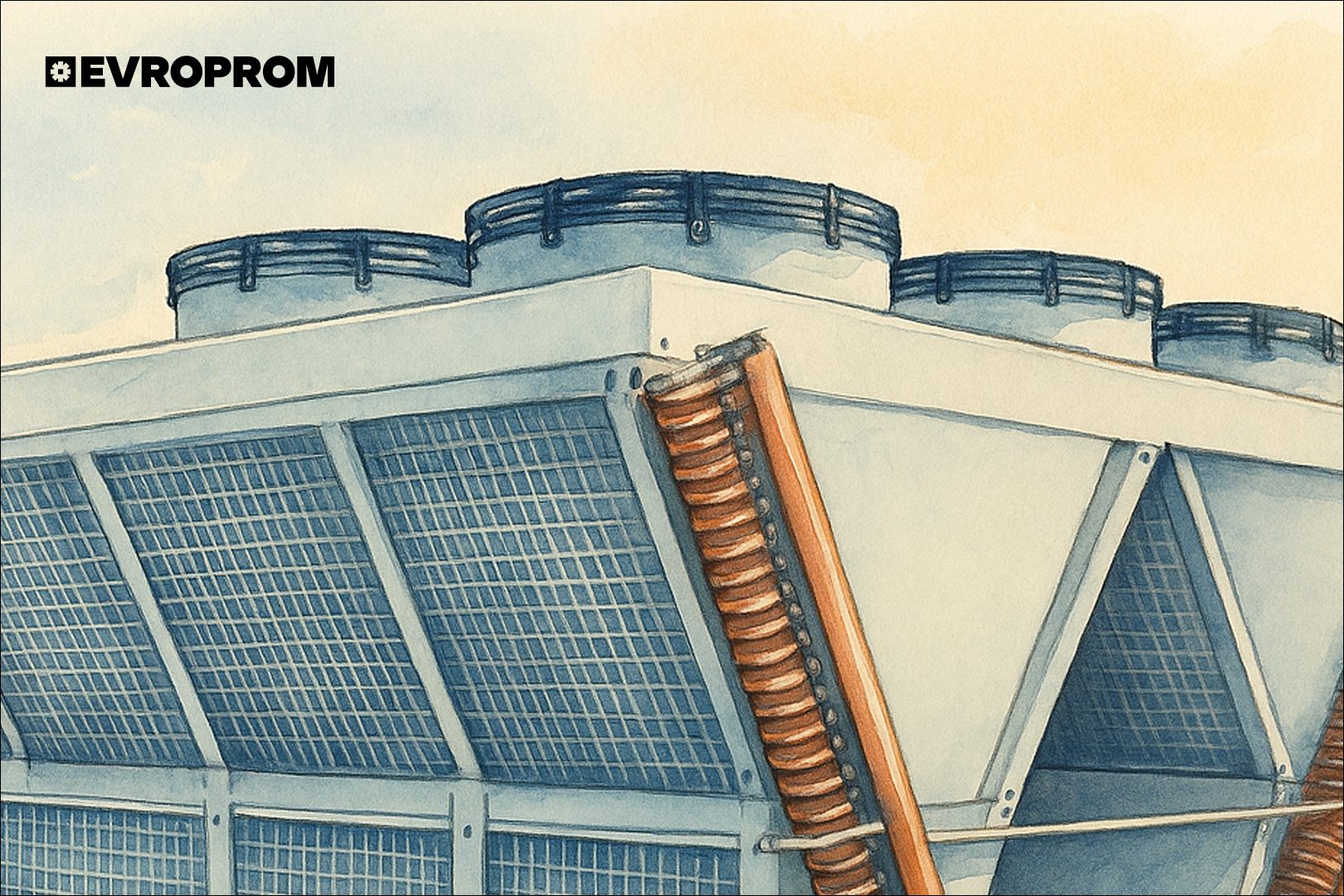
Use of Chillers with Free Cooling in Extrusion-Type Production and Injection Molding Machines

Introduction
Cooling is one of the key factors for stable operation of extrusion lines and injection moulding machines. In these machines, the heat load is generated during plasticisation, moulding and stabilisation of the polymer. Product geometry, cycle speed and surface quality depend on the accuracy of temperature maintenance.
Traditionally, chillers operating on a vapour-compression cycle with a 6-20 °C water-glycol circuit are used for heat removal. However, the compressor remains a major energy consumer and cooling costs often reach 30-40 % of the plant’s energy balance. In year-round operation, this leads to excessive energy consumption during periods when the outside temperature already allows the use of natural cold.
Free cooling technology (free cooling) makes it possible to utilise the low temperature of the outside air to cool the heat transfer medium without the need for a compressor. The cold is produced naturally through a heat exchanger or drycooler, which reduces energy consumption by up to 70-80% in winter and autumn.
For plants where the process is continuous and requires high reliability, free-cooling chillers provide the optimum balance between temperature stability and energy efficiency. The effect is particularly noticeable in temperate regions, where outdoor temperatures of -5 to 10 °C remain between -5 and 10 °C for a large part of the year.
If you need help in selecting a chiller for your facility, contact EVROPROM engineers – we will find the optimal solution taking into account your wishes and operating conditions.
Specifics of cooling in polymer production
In extrusion and injection moulding, the cooling system is responsible for the thermal stability of moulds, cylinders and calibrators. Heat dissipation must be continuous and uniform, as even short-term temperature deviations of ±0.5 °C cause mould defects, internal stresses or cycle fluctuations.
The temperature range of most processes is 8-20 °C, sometimes as low as 5 °C when working with thin-walled or technical plastics. The system is usually constructed as a two-circuit system:
low temperature circuit (6-10 °C) – for moulds and cooling baths;
a high-temperature circuit (15-25 °C) for hydraulics and secondary components.
A typical scheme includes an aggregated refrigeration machine, buffer tank, pumping station and distribution manifold. For reliability, redundant pumps and automatic temperature control depending on load and outdoor conditions are used.
As the air temperature is lower than the cooling water temperature for most of the year, it is possible to switch to free cooling. This is particularly effective for polymer production facilities. Free-cooling mode can provide up to 50-70 % of annual cooling capacity without compressor operation, maintaining stability of technological parameters and reducing energy costs of the enterprise.
Principle of operation of free-cooling systems
Free cooling (free cooling) is a mode of free cooling, in which the cold is produced without the participation of a compressor due to the heat exchange between the outside air and liquid coolant. The basic idea is that when the outside air temperature drops below the temperature of the coolant, part or all of the cooling capacity can be provided naturally.
The operating scheme comprises two circuits: compressor and free-cooling. At high outside temperatures, the standard refrigeration cycle operates. As the temperature drops, the automation gradually opens the three-way valve, directing the flow of glycol through the heat exchanger-drycooler. In the partial free-cooling mode, the compressor part operates at a reduced level, and the dricooler provides pre-cooling of the coolant. When the outside air temperature drops further, the compressors are completely switched off and the unit switches to full free-cooling mode, when cooling is carried out solely by natural heat exchange.
The capacity of the drycooler is determined by the air temperature and velocity, the heat exchange area and the coolant flow rate. In order to maintain the required temperature, the circuit is equipped with frequency controlled fans, which allows smooth regulation of the blowing intensity and minimises energy consumption.
Depending on the system configuration, there are three main variants:
- direct free-cooling, when the cooling process is carried out directly through a heat exchanger between the outside air and the process circuit;
- indirect (glycol) free-cooling, where an intermediate heat exchanger is installed between the process circuit and the drycooler;
- combined mode, where both cooling sources operate in parallel, ensuring a smooth transition between seasons.
For automatic control the temperature switching logic is used, where the threshold values (e.g. 8… 10 °C for 12/7 °C water) are determined by the calculated heat exchange balance. This algorithm eliminates “dead zones” in the off-season and maintains a stable coolant temperature with minimal energy consumption.
Design solutions of free-cooling chillers
There are two approaches to the implementation of free-cooling systems: integrated and separate.
Integrated free -coolingchillers are a monoblock in which the drycooler, compressor circuit and hydronic system are combined in one housing. When the outside air temperature drops, the valve group automatically directs the glycol flow through the air heat exchanger section, bypassing the evaporator. Such solutions are produced by many manufacturers – Trane, Daikin, Johnson Controls, Climaveneta, BlueBox. They are easy to operate, but require free air access and a carefully selected heat exchange surface to ensure efficient operation at low temperatures.

Fig. 1 – Dry cooling tower integrated into the cooling unit design
Split systems consist of a standard chiller and an external drycooler connected in parallel via a plate heat exchanger. This variant is more flexible: it allows the addition of free-cooling to existing units, as well as changing the flow ratio during system refurbishment. The control is realised at the hydronic module level with three-way valves and return temperature sensors.
In both cases, the working fluid is a water-glycol solution with a concentration of 30-35 %, which prevents freezing at temperatures as low as -10 °C. To increase efficiency, EC fans and frequency drives are used to ensure smooth capacity control.
An important design feature is the calculation of the switching temperature between modes. For example, for systems with a fluid temperature of 12/7 °C, free-cooling becomes economically feasible at outdoor temperatures below 8 °C. In colder regions, this allows up to 2,500-3,500 hours of operation per year without compressors being switched on, which corresponds to energy savings of 50-60 per cent.
Modern controllers such as Carel pCO, Siemens Climatix or Johnson Controls Metasys provide integrated control of the compressor and freecooling circuits, including weather-dependent optimisation and subcooling protection. As a result, the system runs continuously, automatically adapting to seasonal changes and minimising energy consumption without operator intervention.

Fig. 2 – Couple: cooling unit dry cooling tower free-cooling system
Take a look at our catalogue of chillers – units in various configurations, carefully checked for defects, set to the required temperature settings and shipped to you in perfect condition.
Energy efficiency and savings calculations
The efficiency of free-cooling is primarily determined by the reduced running time of the compressors. In a standard vapour-compression cycle, around 70-80 % of the energy consumed is in the compressor section. In free cooling mode, the compressors are either completely switched off or run at reduced capacity, and the coolant is cooled by heat exchange with the outside air, which reduces the energy consumption of the system by 3-5 times.
When calculating the energy effect, the annual temperature profile of the region is used. For process circuits with inlet/outlet parameters of 12/7 °C, savings start at outdoor air temperatures below 8 °C. In the Ukrainian climate, this corresponds to approximately 3000-4000 h per year of potential free-cooling operation.
For systems with a lower level of heat transfer medium, e.g. 8/5 °C, free cooling mode is possible for about 2000-2500 h per year and the remaining time in mixed mode with partial compressor unloading.
Assuming that the chiller has a capacity of 300 kW of cooling and its average energy efficiency ratio (EER) = 3, the electricity consumption without free-cooling is approx
W without = 300 / 3 = 100 kW.
In freecooling mode, the consumption is limited by the operation of the drycooler fans and pumps – about 15-20 kW. Thus, with 3000 hours of free cooling operation, the annual energy savings will be:
ΔW = (100-20) × 3000 = 240,000 kW × h.
Even at an electricity cost of 8 UAH/kWh, this is more than 1,920,000 UAH per year for one medium-capacity chiller.
Energy efficiency is often expressed through the seasonal SEER (Seasonal Energy Efficiency Ratio). For conventional chillers SEER ≈ 3-3.5, while for systems with free-cooling this indicator increases to 5-6 due to long periods of free cooling.
An additional effect is achieved by reducing the operating load on the compressors. With partial operation or complete shutdown, the service life of the compressor sections is increased by 20-30 % on average, while service and replacement costs are reduced.
The thermal efficiency of the drycooler depends on the temperature difference and air flow rate. When the outside air temperature drops to -5…0 °C, the capacity of the drycooler can reach 80-100 % of the nominal cooling capacity. At the same time, power consumption of fans (even with frequency control) does not exceed 10-15 % of the compressor mode consumption.

Fig. 3 – Change of atmospheric air temperature in Odessa, for the period from 01.06.2021 to 01.06.2022

Fig. 4 – Accumulated sum of atmospheric air temperature in Odessa, for the period from 01.06.2021 to 01.06.2022

Fig. 5 – Change of atmospheric air temperature in Kiev, for the period from 01.06.2021 to 01.06.2022

Fig. 6 – Accumulated sum of atmospheric air temperatures in Kyiv, for the period from 01.06.2021 to 01.06.2022
The results of the climatic analyses conducted earlier for Odessa and Kiev can be directly transferred to the range of temperatures characteristic for cooling of polymer production facilities. For the conditions in Kiev, about 3800 h per year are observed at outdoor temperatures below 8 °C, while for Odessa about 2700 h are observed. This means that even in southern regions the share of free cooling can reach 40-45 % and in central and northern regions 60-70 % of the total system operating time.
Thus, the use of free-cooling allows:
- reduce the annual energy consumption of the system by 40-60 %;
- increase the life of compressors and heat exchangers;
- improve the overall seasonal energy efficiency of the plant.
On average, the integration of free-cooling into the cooling system of extrusion or injection moulding lines pays for itself in 1.5-2 years, after which operating costs are reduced in proportion to the share of free cooling time.
The implementation of free-cooling in extrusion and injection moulding machines is based on the principle of integrating free cooling into the existing process water circulation system. The scheme is designed in such a way as to ensure an automatic transition between three modes: compressor, mixed and free cooling.
The typical layout includes a cooling unit with a water-glycol circuit, a drycooler and a hydronic module with a three-way valve. During the warm period, the entire flow passes through the evaporator of the chiller. When the outside temperature drops to the design threshold (typically 8… 10 °C), the valve partially directs the flow to the drycooler, providing pre-cooling. When the temperature drops further, the circuit switches completely to free-cooling and the compressors stop automatically.
In extrusion lines, cooling water is used to stabilise the temperature of calibrators, vacuum baths and screw cooling. The coolant flow is distributed to manifolds where a constant flow rate and pressure are maintained. The introduction of free-cooling in such a scheme is done at the level of the buffer tank – it is through this tank that the heat exchange between the process circuit and the drycooler takes place, which prevents temperature fluctuations during mode changes.
For reliability, the system is equipped with two pumps (working and standby) and servo-controlled control valves. Modern controllers(Carel, Siemens, Dixell, Danfoss) control the fans of the drycooler by frequency and regulate the position of three-way valves depending on the return temperature. This ensures a smooth transition between modes without pressure and temperature jumps.
Freecooling can be installed both as part of new equipment and when modernising existing refrigeration systems. In the latter case, the most rational solution is to connect an external drycooler in parallel to the existing circuit through an additional heat exchanger. Such modernisation does not require any intervention in the compressor part and allows using free-cooling for most of the year.
From an operational point of view, free-cooling does not require constant maintenance. The only critical units are coolant filters and temperature sensors, the accuracy of which determines the correct operation of the automation. For systems with water-glycol mixtures it is important to maintain glycol concentration at the level of 30-35 % and monitor its condition at least once a year.
In practice, the introduction of free-cooling at polymer processing enterprises gives a complex effect. In addition to reducing energy consumption by 40-60 %, the heat load on compressors is reduced, the service life of equipment is prolonged and the number of service interventions is reduced. Free-cooling is especially advantageous in production cycles operating around the clock: the system stably switches to natural mode when the outside air temperature drops, ensuring constant cooling capacity without the need for personnel.
In the climatic conditions of Ukraine, where the average duration of the cold period is 5-6 months, free-cooling is able to provide up to 50% of the annual cooling time of process water in extrusion and injection moulding lines. This makes it not just an energy-saving addition, but a standard for modern production systems focused on reducing operating costs and increasing the reliability of the process cycle.
Feasibility study
The economic feasibility of implementing free-cooling in cooling systems of extrusion lines and injection moulding machines is determined by the ratio of capital investments and annual energy savings. In this case, the key role is played by the climatic duration of the period when the outdoor temperature allows the use of free cooling.
For a 300 kW chiller with integrated free-cooling, the average additional equipment cost is 10-15 % of the base unit price. In absolute figures, this is about 15-20 thousand euros for a total installation cost of about 120-150 thousand euros.
Annual energy savings, as shown in the previous section, reach 200-250 MWh, which at an average electricity cost of 0.2 €/kWh corresponds to 40-50 thousand euros per year. Thus, the payback period of the system is less than one year in the northern and central regions of Ukraine and 1-1.5 years in the southern regions.
In climatic terms, the use of free-cooling is particularly effective when average monthly temperatures are below 10 °C for at least five months of the year. For Kiev, Lviv, Kharkiv or Dnipro, the share of free cooling exceeds 60 % of the annual time, which allows to achieve a seasonal energy efficiency ratio SEER ≈ 5.5-6.0. For Odessa and Mykolaiv, where winters are milder, the figure drops to SEER ≈ 4.5, but even here the energy savings exceed 40 %.
An additional factor of economic benefit is the reduction of operating costs. By reducing the operating hours of the compressors, the service life of the units increases by 20-30 %, which reduces the frequency of maintenance and delayed repairs. This also reduces the load on the company’s electrical infrastructure – transformers and distribution boards operate at lower peak power, which increases reliability and reduces heat losses in the network.
The financial assessment of efficiency can be expressed through the present value of ownership (PVO). For an installation without free-cooling, the IRV for 5 years of operation includes:
PCV without = Ccapex5 × Cenergy
For a chiller with free-cooling:
WWTPc = (Ccapex× 1.15) 5 × (Cenergy×0.6)
Even with a 10% increase in capital cost, the total cost over 5 years is reduced by about 35-40%, which confirms the high investment efficiency.
In practice, companies using Climaveneta FX-FC, Trane Sintesis E-FC or Daikin EWAD-TZB FC equipment, note a real reduction in electricity consumption for cooling process water by 45-60 % in continuous operation. In a production environment, this is equivalent to saving 700-900 MWh over 3 years and reducing the carbon footprint by tens of tonnes of CO₂.
When designing a new system, it is recommended to include free-cooling from the start – an integrated solution is cheaper and more compact than subsequent modernisation. However, even for existing lines, modernisation with the installation of an external dricooler pays for itself within 2-2.5 years, especially if the plant operates around the clock and consumes cooling water in a constant volume.
Thus, free-cooling in polymer processing production systems is not just an energy-saving option, but an economically feasible standard that reduces operating costs, increases reliability and reduces the impact on the plant’s energy system.
Conclusions
Application of free-cooling in cooling systems of extrusion lines and injection moulding machines represents a technologically mature and economically justified direction of increasing energy efficiency of production processes. Analyses of the operating principle, design solutions and climatic conditions of operation show the following.
- Technological compatibility.
The cooling temperature levels in polymer processing (6-20 °C) are ideally matched to the range in which natural cooling can be utilised. This makes free-cooling the most effective for applications where continuous and stable heat dissipation at moderate temperatures is required. - Energy efficiency.
In the climatic conditions of Ukraine, free-cooling systems are able to provide free cooling 40… 50 % of the annual time, which leads to a ~40% reduction in electricity consumption and an increase in the seasonal energy efficiency ratio SEER to 5.5-6.0. - Economic Impact.
With average capital costs increased by 10-15 %, annual energy savings will fully compensate investments within 1-2 years. In addition, operating costs are reduced by extending compressor life and reducing service frequency. - Design flexibility.
Free-cooling can be implemented both as part of new units (integrated solution) and in the modernisation of existing systems with the installation of an external drycooler and intermediate heat exchanger. The second option is especially attractive for enterprises where equipment modernisation is carried out in stages without stopping production. - Reliability and operation.
Modern automation systems(Carel, Siemens, Johnson Controls, Dixell) provide smooth switching between modes and precise maintenance of return temperature, which eliminates the risks of thermal fluctuations and guarantees stable operation of technological processes. - Environmental aspect.
By reducing electricity consumption by hundreds of megawatt-hours per year, CO₂ emissions are reduced, which meets modern energy management requirements and ISO 50001 standards.
In general, the introduction of free-cooling refrigeration systems in extrusion and injection moulding plants provides a triple effect: energy savings, extension of equipment life and increased process stability. In the context of rising energy costs and tightening energy efficiency standards, such systems are becoming not an additional option, but the optimal design standard for industrial refrigeration systems.
If you still have questions about equipment selection, please contact Europromspecialists. We will help you choose the right solution and offer reliable chillers presented in our catalogue.

What you get with EVROPROM
Optimal chiller selection for your tasks – we take into account operating modes, seasonal load fluctuations, reliability and energy efficiency requirements. We help you choose the optimal compressor type depending on the specifics of the facility.
Technical expertise and calculations – we provide energy efficiency comparisons (COP, EER), forecast operating costs, and calculate payback period for equipment replacement.
Up-to-dateand proven equipment – a wide range of chillers of world brands with different types of compressors and heat exchangers, adapted for industrial, commercial and infrastructure facilities.
Reduced operating costs – by using energy efficient solutions (turbo compressors, frequency control, optimised hydraulics) we reduce annual energy consumption and service costs.
Support at all stages – from the survey of existing systems and design to delivery, installation, commissioning and subsequent maintenance.

Author of the article:
Dmytro Lychak, CEO of the company
28.11.2025