


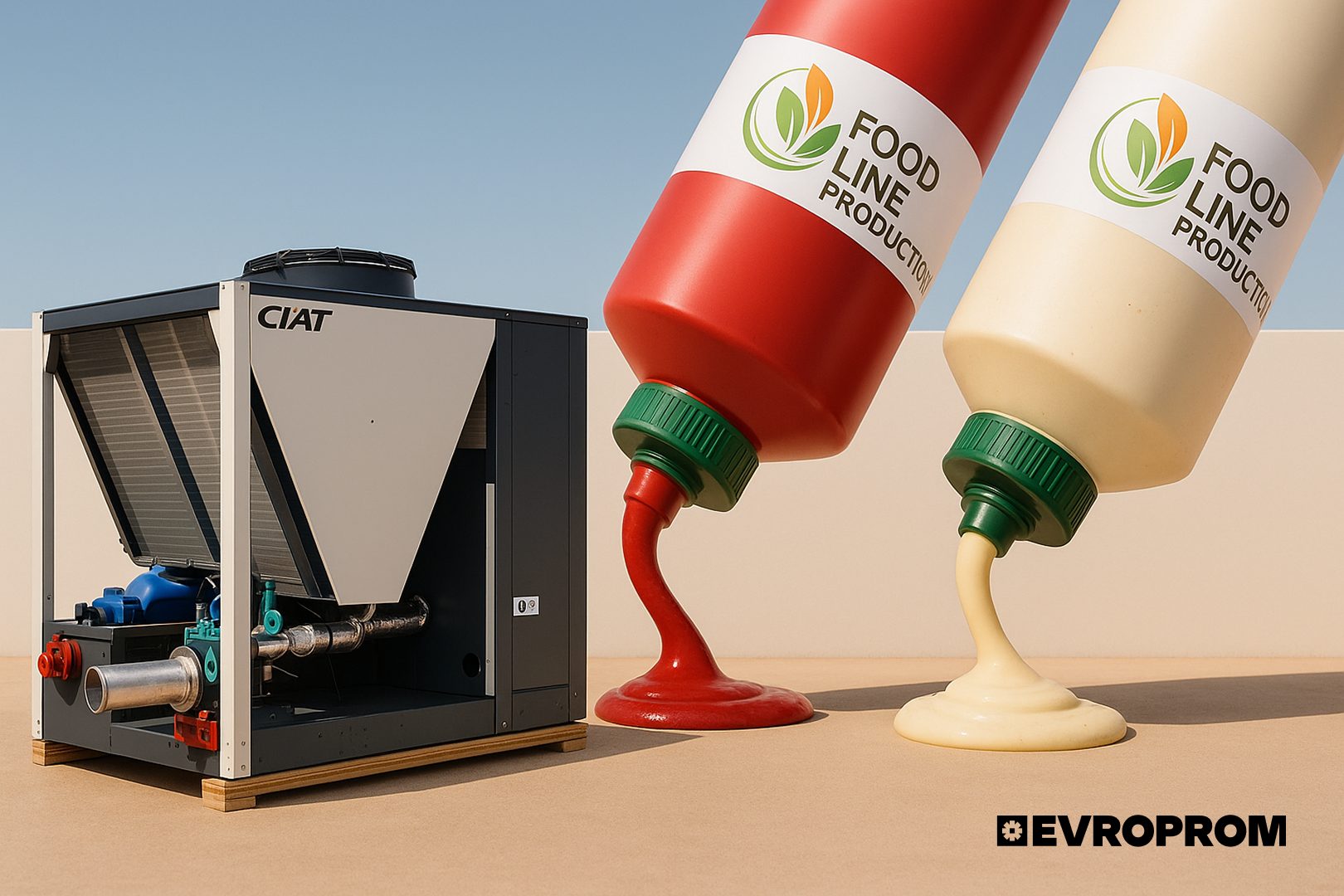
Food Production Cooling: 70% Savings with EVROPROM

Foodline Production is a Ukrainian producer of sauces and dressings, which has been operating on the market for more than 15 years. The company produces up to 25 thousand tonnes of products per year, of which about 60% are sold through national retail chains, and 40% are supplied to the HoReCa segment and for export. The products are presented in more than 2 thousand points of sale in Ukraine and abroad.
The company’s assortment includes over 40 items: ketchups, soya sauces, marinades, spicy dressings and lines for restaurants and supermarkets. Up to 70 tonnes of finished products are shipped daily from the plant, which requires high precision in production processes.
A key feature of the technological cycle is strict temperature control. At the filling stage, each batch must be cooled to 25 °C, otherwise organoleptic properties are lost and shelf life is shortened. At the same time, the heat flows generated during cooking and product preparation reach 90-40 °C and form the main load on the cooling system.
Production is year-round, with up to 330 working days per year. In summer, the peak loads on the system reach up to 270 kW of cooling per hour, which is equivalent to an electricity consumption of around 100 kW. During the winter months, the load is lower, but the system must provide uninterrupted cooling under all external conditions.
For an enterprise with such a volume of work, an increase in the electricity tariff by only 1 hryvnia per kWh increases annual costs by more than UAH 2 million. Any increase in the cost of energy or maintenance is instantly reflected in the cost of production and can affect the company’s position on the retail shelf and in negotiations with chains. That is why the efficiency of cooling systems becomes a strategic factor in the manufacturer’s business model.
A new approach to production design
EVROPROM specialists, developing a cooling system for Foodline Production.
In a classical scheme with one chiller with a capacity of 270 kW, the electricity consumption would reach about 100 kW per hour. If we take into account year-round operation with a nominal load of 8,400 hours, this translates into more than 850,000 kWh per year.
At a tariff of 0.12 €/kWh, the company would spend around 102,000 € on cooling alone, excluding service and maintenance costs.
To reduce energy consumption, EVROPROM proposed a hybrid solution based on a combination of a CIAT ILDCM heat pump chiller and a Carrier drycooler. This approach made it possible to redistribute the heat load: the drycooler removes high-temperature flows in the range of 45-30 °C, relieving the chiller and reducing its operating time by almost 60 per cent in the off-season. As a result, the share of free “dry” cooling reaches up to 4,000 hours per year, saving more than 350,000 kWh.
The final energy balance is as follows: the chiller now operates mainly in the 40-25 °C range, ensuring high efficiency with a COP ≈ 4.5. This allows the same 270 kW of cooling to consume no more than 60-65 kW of electricity per hour. The total annual savings of the company exceed 40 per cent, i.e. around 40,000 € annually.
With an average project cost, the payback period was less than 3 years, and further operation provides direct benefits and a reduced carbon footprint by reducing CO₂ emissions by more than 150 tonnes per year.
–Refrigeration capacity of 139.2 kW, which allows key processes to be covered without overloading the system;
– Thermal capacity – 147.8 kW, which means that the unit not only cools but also returns energy in each of the cycles;
– Two independent circuits and four Copeland scroll compressors give redundancy and resilience at peak loads;
– R410A refrigerant guarantees stability of operation and complies with modern, international and environmental standards;
– Heat recovery reduces overall energy costs and increases efficiency by 10-15% by preserving heat load;
– Built-in hydronic module with water pump and expansion tank simplifies integration – less installation work, faster start-up.
–Refrigeration capacity in the range 356-484 kW gives a wide margin for fluctuations and demands from production loads;
– Ten 900 mm diameter axial fans ensure uniform airflow even during peak heat periods;
– Efficient heat dissipation in the 90-40 °C range relieves the chiller and extends the service life of the equipment by up to 30-40%;
– The design of the drycooler is adapted to operate up to 8,000 hours per year without loss of efficiency at every stage of industrial refrigeration.
Co-operative operation of the cooling system:
The drycooler takes the bulk of the high-temperature loads and works in cooling for up to 4,000 hours per year, equivalent to almost half of the calendar time. This reduces compressor switching by more than 55 per cent and thus reduces annual energy consumption by 320,000-340,000 kWh, preserving the customer’s investment.
The chiller is only operated in the lower temperature range of 40-25 °C, where the energy efficiency factor exceeds 3.2. Translated, this means that the system consumes no more than 60-65 kW of electricity to produce 270 kW of cooling, whereas the classic scheme required 100 kW.
In annual terms, the difference reaches 450,000 kWh, which, at an average electricity price of 0.12 €/kW per hour, saves the company more than 50,000 euros annually in net savings on industrial refrigeration.
Efficiency in figures
In summer, the drycooler takes up to 55 % of the heat load. As a result, the actual energy consumption of the chiller is reduced to 40-45 kWh, compared to 100-105 kWh in a classic scheme. With an average summer season of 120 days and a load of 18 out of 24 hours, this means:
– A standard solution would have consumed more than 220,000 kWh;
– The combined scheme – about 95,000 kWh;
– The difference is almost 125,000 kWh in one summer season.
In winter, cooling is only provided by the drycooler and the chiller is completely switched off. The auxiliary systems consume no more than 5-6 kWh. Over four winter months, this generates a total consumption of around 15,000-18,000 kWh, whereas a classic system would have consumed more than 300,000 kWh. The saving is 285,000 kWh per winter.
In the annual balance, the benefit becomes obvious. With a design load of 270 kW of refrigeration, a standard system would consume around 850,000-900,000 kWh per year. The implemented scheme reduces the figure to 220,000-250,000 kWh. The saving is 600,000-650,000 kWh annually, which corresponds to 70-75,000 euros in money. For a precise comparison, this is equivalent to the annual energy consumption of 280 flats of 60 m² or a reduction of CO₂ emissions of more than 520 tonnes per year into the atmosphere.
Cost impact in business strategy
Energy savings allow Foodline Production PP to reduce production costs and reallocate resources to the development of new sauce lines. The combined refrigeration system reduces the workload of staff, allowing them to focus on improving recipes and introducing innovative packaging, which has a positive impact on net margins.
The EVROPROM solution ensures uniform cooling at a critical 25 °C, eliminating any temperature fluctuations.
This ensures that the sauce retains a consistent flavour and texture even during peak shifts. The production process is more predictable and the product quality is consistent.
This approach strengthens the trust of our network customers and allows us to expand our distribution channels without the risk of compromising product standards.
Why is combined cooling efficient?
The combination of a CIAT ILDCM chiller and a Carrier drycooler provides real energy efficiency: the average annual energy cost reduction reaches 70-80% and the payback period is 2-3 years. In summer, the drycooler removes up to 55% of the heat load, reducing the chiller operation from 100 kWh to 40-45 kWh. In winter, the chiller is almost never switched on, leaving the drycooler to fully handle cooling, making energy consumption predictable and minimising the risks of peak loads.
The innovation of the solution is shown in the rejection of the standard single chiller scheme. EVROPROM designs the system for the specific process cycle: each component is selected to take account of real loads and seasonal variations, and the distribution of cooling capacity between the drycooler and chiller optimises energy consumption without compromising process stability.
Reliability and transparency are ensured by all proven CIAT and Carrier equipment performance, engineering calculations, practical tests and proven operation. This approach guarantees stable cooling at critical 25 °C, eliminates temperature fluctuations, preserves product quality and increases the confidence of network and B2B customers in EVROPROM for 11 years.

Why choose EVROPROM for HVAC system design?
EVROPROM’s approach to HVAC system design demonstrates its comprehensiveness and attention to detail: precise engineering calculations, equipment selection for specific technological processes, integration of components of world brands, full cycle from design to commissioning and service support. Each delivery is accompanied by a quality guarantee, customs coverage and equipment insurance.
For food manufacturers, this provides:
– Lower production costs due to rational distribution of energy consumption; the company saves hundreds of thousands of kWh annually, which directly affects the price of the finished product and allows it to invest in new lines of sauces or improved packaging;
– Increased competitiveness and margins; stable production processes and precise adherence to the 25 °C temperature regime strengthen the position in the HoReCa and retail markets, increasing the trust of chain customers and encouraging repeat orders;
– Minimise the risk of disruption during peak seasons; the combined chiller-drycooler scheme allows high loads in summer and low loads in winter without overloading, making production predictable and reducing dependence on external factors;
– Quality stability and trust from network and B2B customers; uniform cooling eliminates hot spots in the process cycle, preserves the flavour, texture and shelf life of sauces, which increases partner loyalty and strengthens brand reputation.
By choosing EVROPROM, the company receives a complete engineering solution. Where each component is selected with the specifics of production in mind. This turns an ordinary cooling system into a strategic tool: economy and quality become a competitive advantage, and a stable technological process becomes a guarantee of business growth and development.

Author of the article:
Svyatoslav Ovcharenko, Sales Manager
27.09.2025